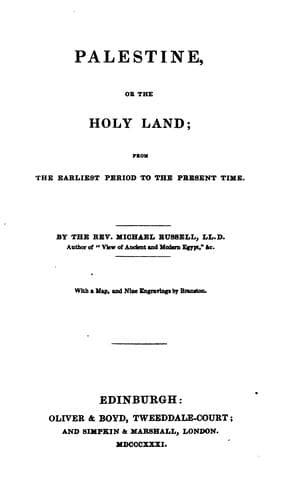
Palestine, or, the Holy Land: From the Earliest Period to the Present TimeRussell, Michael
History
Palestine, or, the Holy Land: From the Earliest Period to the Present Time
Russell, Michael
Palestine -- Description and travel; Palestine -- History
Towards the close of the year, after being joined by a body of English
volunteers, the French monarch resolved to march to Cairo and attack the
sultan in the heart of his kingdom. But the floods of the Nile, and the
intersection of the country by numerous canals, occasioned a second time
the loss of a brave army. Famine and disease, too, aided the sword of the
enemy, till at length the victors of Damietta were compelled to sue for a
peace which they could no longer obtain. A retreat was ordered; but those
who attempted to escape by the river were taken prisoners, and the fate of
such as proceeded by land was equally disastrous. While they were occupied
in constructing a bridge over a canal, the Saracens entered the camp and
murdered the sick. The valiant king, though oppressed with the general
calamity of disease, sustained boldly the shock of the enemy, throwing
himself into the midst of them, resolved to perish rather than desert his
troops. One of his attendants succeeded at length in drawing him from the
presence of the foe, and conducted him to a village, where he sunk under
his wounds and fatigue into a state of utter insensibility. In this
miserable condition he was overtaken by the Moslems, who announced to him
that he was their captive. One of his brothers, the gallant Artois, had
already fallen in battle, but the two others, Anjou and Poictiers, with
all the nobility, fell into the hands of the enemy.
The sultan did not abuse his victory, nor seek to impose upon Louis terms
which a sovereign could not grant without forfeiting his honour. He agreed
to accept a sum equivalent to five hundred thousand livres for the
deliverance of the army, and the town of Damietta as a ransom for the
royal person. Peace was to continue ten years between the Mussulmans and
the Christians; while the Franks were to be restored to those privileges
in the kingdom of Jerusalem which they had enjoyed previous to the recent
invasion of the French. The repose which succeeded this treaty was
interrupted by the murder of the sultan, who fell a victim to the
jealousy, of the Mamlouks; but after a few acts of hostility too
insignificant to be recorded, the emirs renewed, with a few modifications,
the basis of the agreement on which the peace was established. Louis
himself made a narrow escape from the sanguinary intrigues of those
military slaves who had imbrued their hands in the blood of their own
master. They declared that, as they had committed a sin by destroying
their sultan, whom, by their law, they ought to have guarded as the apple
of their eye, their religion would be violated if they suffered a
Christian king to live. But the other chiefs, more honourable than the
Mamlouks, disdained to commit a crime under any such pretext; and the
French monarch, accordingly, was allowed to accompany the poor remains of
his army to the citadel of Acre.
Public-domain text, read in full here on John Shaqi.
Reviews
Reviews
No reviews yet
Be the first to share your thoughts on this work.
Elsewhere in the archive
Join the Discussion
Join the discussion
Sign in to leave a comment or review.
Sign InorCreate an account