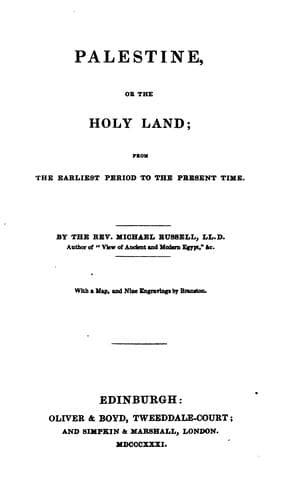
Palestine, or, the Holy Land: From the Earliest Period to the Present TimeRussell, Michael
History
Palestine, or, the Holy Land: From the Earliest Period to the Present Time
Russell, Michael
Palestine -- Description and travel; Palestine -- History
Although no expedition from the Christian states reached the Holy Land
after the close of the thirteenth century, the fire which had so long
warmed the hearts of the Crusaders was not entirely extinguished in
several parts of Europe. Edward the First of England, for example, still
cherished the hope of opening the gates of Jerusalem, or of leaving his
bones in the sacred dust of Palestine. A similar feeling animated the
monarch of France; while the pope, who derived manifold advantages from
the prosecution of such wars, summoned councils, issued pastoral letters,
and employed preachers, as in the days that were past. But dissensions at
home during the first half of the fourteenth century, and the general
conviction of hopelessness which had seized the public mind respecting all
armaments against the Moslems, occasioned the failure of every attempt to
unite once more the powers of Chistendom in the common cause.
In the following century, the ascendency of the Turks, not only in the
East, but on the banks of the Danube and the northern shores of the
Mediterranean, compelled the people of Europe to act on the defensive. The
fall of the Grecian empire, too, rendered the intercourse with Syria at
once more difficult and dangerous. Egypt in like manner was shut against
the Christians, being subjected to the same yoke which pressed so heavily
on the western parts of Asia. Hence, during more than two centuries a
cloud hung over the affairs of Palestine, which we in vain attempt to
penetrate. Suffice it to remark, that it remained subject to the Mamlouk
sultans of Egypt till the year 1382, when they were dispossessed by a body
of Circassians, who invaded and overran the country. Upon the expulsion of
these barbarians, it acknowledged again the government of Cairo, under
which it continued until the period of the more formidable irruption of
the Mogul Tartars, led by the celebrated Tamerlane. At his death the Holy
Land was once more annexed to Egypt as a province; but in 1516, Selim the
Ninth, emperor of the Othman Turks, carried his victorious arms from the
Euphrates to the Libyan Desert, involving in one general conquest all the
intervening states. More than three hundred years have that people
exercised a dominion over the land of Judea, varied only by intervals of
rebellion on the part of governors who wished to assert their
independence, or by wars among the different pashas, who, in defiance of
the supreme authority, have from time to time quarrelled about its spoils.
Public-domain text, read in full here on John Shaqi.
Reviews
Reviews
No reviews yet
Be the first to share your thoughts on this work.
Elsewhere in the archive
Join the Discussion
Join the discussion
Sign in to leave a comment or review.
Sign InorCreate an account