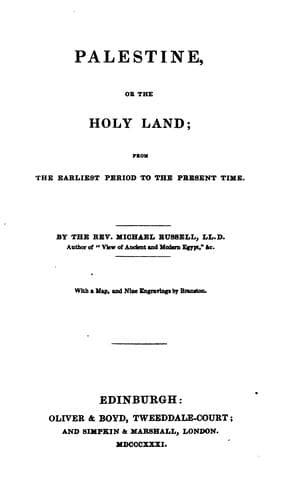
Palestine, or, the Holy Land: From the Earliest Period to the Present TimeRussell, Michael
History
Palestine, or, the Holy Land: From the Earliest Period to the Present Time
Russell, Michael
Palestine -- Description and travel; Palestine -- History
From the period at which the Crusaders were expelled from Syria down to
the middle of the last century, we are chiefly indebted for our knowledge
of the Holy Land to the pilgrims whom religious motives induced to brave
all the perils and extortions to which Franks were exposed under the
Turkish government. The faith of the Christians survived their arms at
Jerusalem, and was found within the sacred walls long after every European
soldier had disappeared. The Jacobite, Armenian, and Abyssinian believers
were allowed to cling to those memorials of redemption which have at all
times given so great an interest to the localities of Palestine; and
occasionally a member of the Latin Church had the good fortune to enter
the gates of the city in disguise, and was permitted to offer up his
prayers at the side of the Holy Sepulchre. In 1432, when La Broquiere
undertook his pilgrimage into the East, there were only two French monks
in Jerusalem, who were held in the most cruel thraldom.
The increasing intercourse between the Turks at Constantinople and the
governments of Europe gradually produced a more tolerant spirit among the
former, and paved the way for a lasting accommodation in favour of the
Christians in Palestine. We find, accordingly, that in the year 1507, when
Baumgarten travelled in Syria, there was at Jerusalem a monastery of
Franciscans, who possessed influence sufficient to secure his personal
safety, and even to provide for his comfort under their own roof. At a
somewhat later period, the Moslem rulers began to consider the reception
of pilgrims as a regular source of revenue; selling their protection at a
high price, and even creating dangers in order to render that protection
indispensable. The Christians, meantime, rose by degrees from the state of
depression and contumely into which they were sunk by the conquerors of
the Grecian empire. They were allowed to nominate patriarchs for the due
administration of ecclesiastical affairs, and to practise all the rites of
their religion, provided they did not insult the established faith,--a
condition of things which, with such changes as have been occasioned by
foreign war or the temper of individual governors, has been perpetuated to
the present day.
Public-domain text, read in full here on John Shaqi.
Reviews
Reviews
No reviews yet
Be the first to share your thoughts on this work.
Elsewhere in the archive
Join the Discussion
Join the discussion
Sign in to leave a comment or review.
Sign InorCreate an account