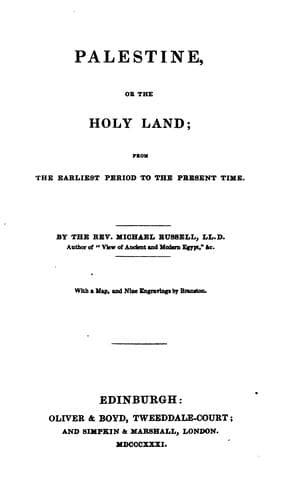
Palestine, or, the Holy Land: From the Earliest Period to the Present TimeRussell, Michael
History
Palestine, or, the Holy Land: From the Earliest Period to the Present Time
Russell, Michael
Palestine -- Description and travel; Palestine -- History
The want of proper means for forming a siege, and perhaps the contempt
which he entertained for barbarians, occasioned a great deficiency in the
works raised before Acre. Bonaparte was not ignorant of the disadvantages
under which his men laboured from the cause now assigned; and was
principally for this reason that he trusted more to the bayonet than to
the mortar or cannon. He repeated his assaults day after day, till the
ditch was filled with dead and wounded soldiers. His grenadiers at length
felt greater horror at walking over the bodies of their comrades than at
encountering the tremendous discharges of large and small shot to which
the latter had fallen victims.
On the 21st of May, after sixty days of ineffectual labor under a burning
sun, Napoleon ordered a last assault on the obstinate garrison of
Ptolemais, which had barred his path to the accomplishment of the most
splendid conquests. This attempt was not less fruitless than those which
had preceded it, and was attended with the loss of many brave warriors. A
fleet was at hand to reinforce Djezzar with men and arms; the French, on
the contrary, were perishing under the plague, which had already found its
way into their ranks, and were, besides, constantly threatened by swarms
of Arabs and Mamlouks, who had assembled in the neighbouring mountains.
His failure in this effort, accordingly, dictated the necessity of a
speedy retreat towards Egypt, where his affairs continued to enjoy some
degree of prosperity, and in the magazines of which he might still find
the means of restoring the health and vigour of his troops.
The siege of Acre, says the biographer of Bonaparte, cost nearly three
thousand men in killed, and of such as died of the plague and their
wounds. Had there been less precipitation in the attack, and had the
advances been conducted according to the rules of art, the town, says he,
could not have held out three days; and one assault such as that of the
8th of May would have sufficed. But he admits that it would have been
wiser in their situation, destitute as they were of heavy artillery and
provisions, while the place was plentifully supplied and in active
communication with the English and Ottoman fleets, not to have undertaken
the siege at all. In the bulletins, he adds, always so veracious, the lose
of the French is estimated at five hundred killed and a thousand wounded;
while that of the enemy is augmented to fifteen thousand. These documents
are doubtless curious pieces for history,--certainly not because they are
true. Bonaparte, however, attached the greatest importance to these
relations, which were always drawn up or corrected by himself.[181]
Public-domain text, read in full here on John Shaqi.
Reviews
Reviews
No reviews yet
Be the first to share your thoughts on this work.
Elsewhere in the archive
Join the Discussion
Join the discussion
Sign in to leave a comment or review.
Sign InorCreate an account