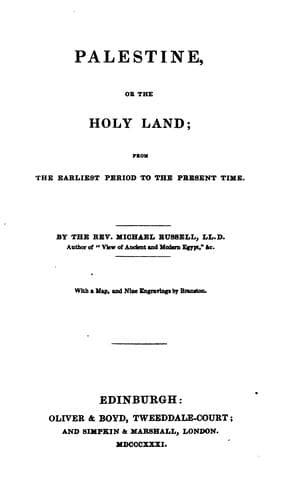
Palestine, or, the Holy Land: From the Earliest Period to the Present TimeRussell, Michael
History
Palestine, or, the Holy Land: From the Earliest Period to the Present Time
Russell, Michael
Palestine -- Description and travel; Palestine -- History
The reader may not be displeased to consider the motives which induced
Napoleon to persevere so long in the siege of Acre. "I see that this
paltry town has cost me many men, and occupies much time; but things have
gone too far not to risk a last effort. If we succeed, it is to be hoped
we shall find in that place the treasures of the pasha, and arms for three
hundred thousand men. I will raise and arm the whole of Syria, which is
already greatly exasperated by the cruelty of Djezzar, for whose fall you
have seen the people supplicate Heaven at every assault. I advance upon
Damascus and Aleppo; I recruit my army by marching into every country
where discontent prevails; I announce to the people the abolition of
slavery, and of the tyrannical government of the pashas; I arrive at
Constantinople with armed messes; I overturn the dominion of the
Mussulman; I found in the East a new and mighty empire which shall fix my
position with posterity; and perhaps I return to Paris by Adrianople or
Vienna, having annihilated the house of Austria."[182]
Whatever accuracy there may be in these reminiscences, there is no doubt
that Napoleon frequently remarked, in reference to Acre, "The fate of the
East is in that place." Nor was this observation made at random; for had
the French subdued Djezzar, and buried his army in the ruins of the
fortress, the whole of Palestine and Syria would have submitted to their
dominion. He expected, besides, a cordial reception from the Druses, those
warlike and semi-barbarous tribes who inhabit the valleys of Libanus, and
who, like all the other subjects of the Ottoman government, had felt the
pressure of the pasha's tyranny. His eyes were likewise turned towards the
Jews, who, in every commotion which affects Syria, are accustomed to look
for the indication of that happy change destined, in the eye of their
faith, to restore the kingdom to Israel in the latter days. It was not,
indeed, till a somewhat later period that he openly extended his
protection to the descendants of Abraham; but it is not improbable that
the notion had occurred to him during his Eastern campaigns of employing
them for the purpose of establishing an independent sovereignty in
Palestine, devoted to his ulterior views in the countries beyond the
Euphrates.
Public-domain text, read in full here on John Shaqi.
Reviews
Reviews
No reviews yet
Be the first to share your thoughts on this work.
Elsewhere in the archive
Join the Discussion
Join the discussion
Sign in to leave a comment or review.
Sign InorCreate an account