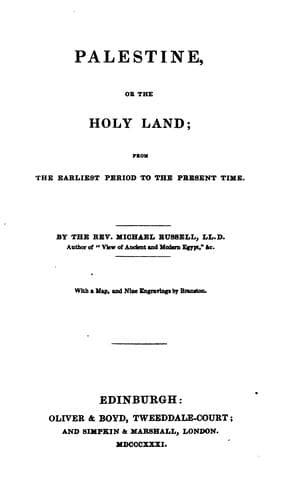
Palestine, or, the Holy Land: From the Earliest Period to the Present TimeRussell, Michael
History
Palestine, or, the Holy Land: From the Earliest Period to the Present Time
Russell, Michael
Palestine -- Description and travel; Palestine -- History
In the minute subdivision of power, which in all cases partakes of the
absolute nature of the supreme government, the traveller is often reminded
of patriarchal times, when there were found judges, and even kings,
exercising a separate dominion at the distance of a short journey from one
another. As an instance of this, we may mention, that on the road from
Jerusalem to Sannour, by way of Nablous, there are no fewer than three
governors of cities, all of whom claim the honours of independent
sovereigns; for, although they acknowledge a nominal superiority in the
Pasha of Damascus, they exclude his jurisdiction in all cases where he
does not enforce his authority at the head of his troops: The same
affectation of independence descends to the sheiks of villages, who, aware
of the precarious tenure by which their masters remain in office, are
disposed to treat their orders with contempt. Like them, too, they turn to
their personal advantage the power of imposition and extortion which
belongs to every one who is clothed with official rank in Syria. They sell
justice and protection; and in this market, as in all others, he who
offers the best price is certain to obtain the largest share of the
commodity.[184]
This chapter would not be complete were we to omit all allusion to the
Jews, the ancient inhabitants of Palestine. Their number, according to a
statement lately published in Germany, amounts to between three and four
millions, scattered over the face of the whole earth, but still
maintaining the same laws which their ancestors received from their
inspired legislator more than three thousand years ago. In Europe there
are nearly two millions, enjoying different privileges according to the
spirit of the several governments; in Asia, the estimate exceeds seven
hundred thousand; in Africa, more than half a million; and in America,
about ten thousand. It is supposed, however, on good grounds, that the
Jewish population on both sides of Mount Taurus is considerably greater
than is here given, and that their gross number does not fall much short
of five millions.[185]
In Palestine of late years they have greatly increased. It is said that
not fewer than ten thousand inhabit Saphet and Jerusalem, and that in
their worship they still sing those pathetic hymns which their manifold
tribulations have inspired; bewailing, amid the ruins of their ancient
capital, the fallen city and the desolate tribes. In Persia, one of them
addressed a Christian missionary in these affecting words:--"I have
travelled far; the Jews are everywhere princes in comparison with those in
the land of Iran. Heavy is our captivity, heavy is our burden, heavy is
our slavery; anxiously we wait for redemption."
Public-domain text, read in full here on John Shaqi.
Reviews
Reviews
No reviews yet
Be the first to share your thoughts on this work.
Elsewhere in the archive
Join the Discussion
Join the discussion
Sign in to leave a comment or review.
Sign InorCreate an account