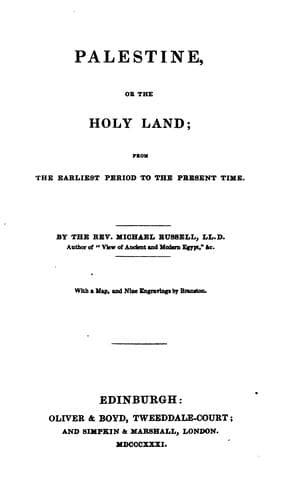
Palestine, or, the Holy Land: From the Earliest Period to the Present TimeRussell, Michael
History
Palestine, or, the Holy Land: From the Earliest Period to the Present Time
Russell, Michael
Palestine -- Description and travel; Palestine -- History
Since the departure of the French no event has occurred to give any
interest to the history of Palestine. The Mussulman instantly resumed his
power, which for a time he appeared determined to exercise with a strong
arm and with little forbearance towards the Franks, from the terror of
whose might he had just escaped. But the ascendency of Europe, as a great
assemblage of Christian states, checks the intolerance of the Turk, and
imposes upon him the obligations of a more liberal policy. Hence we may
confidently assert, that although the members of the Greek and Latin
churches in Syria are severely taxed, they are not persecuted. They are
compelled to pay heavily for the privilege of exercising the rights of
their worship, and of enjoying that freedom of conscience which is the
natural inheritance of every human being; but their property is held
sacred, and their personal security is not endangered, provided they have
the prudence to rest satisfied with a simple connivance or bare permission
in things relating to their faith.
The actual state of the Holy Land may be known with sufficient accuracy
from the topographical description which we have given in a former
chapter. With regard, again, to the civil government of the country, it
has been remarked that the pashas are so frequently changed, or so often
at war with each other, that the jurisdiction of the magistrates in cities
is so undefined, and the hereditary or assumed rights of the sheiks of
particular districts are so various, that it is extremely difficult to
discover any settled rule by which the administration is conducted. The
whole Turkish empire, indeed, has the appearance of being so precariously
balanced, that the slightest movement within or from without seems likely
to overturn it. Everywhere is absolute power seen stretched beyond the
limits of all apparent control, but finding, nevertheless, a counteracting
principle in that extreme degree of acuteness to which the instinct of
self-preservation is sharpened by the constant apprehension of injury.
Hence springs that conflict between force and fraud, not always visible,
but always operating, which characterizes society in all despotic
countries.
Public-domain text, read in full here on John Shaqi.
Reviews
Reviews
No reviews yet
Be the first to share your thoughts on this work.
Elsewhere in the archive
Join the Discussion
Join the discussion
Sign in to leave a comment or review.
Sign InorCreate an account