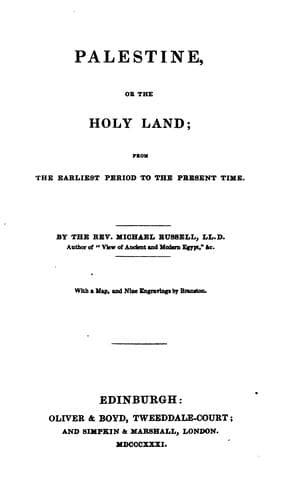
Palestine, or, the Holy Land: From the Earliest Period to the Present TimeRussell, Michael
History
Palestine, or, the Holy Land: From the Earliest Period to the Present Time
Russell, Michael
Palestine -- Description and travel; Palestine -- History
Dr. Clarke remarks, that in the neighborhood of Cana there are several
basaltic appearances. The extremities of columns, prismatically formed,
penetrated the surface of the soil, so as to render the path very rough
and unpleasant. These marks of regular or of irregular crystallization
generally denote, according to his opinion, the vicinity of water lying
beneath their level. The traveller, having passed over a series of
successive plains, resembling in their gradation the order of a
staircase, observes, as he descends to the inferior stratum upon which
the water rests, that where rocks are disclosed the symptoms of
crystallization have taken place, and then the prismatic configuration is
commonly denoted basaltic. Such an appearance, therefore, in the approach
to the Lake of Tiberias is only a parallel to similar phenomena exhibited
by rocks near the Lakes of Locarno and Bolsenna in Italy, by those of the
Wenner Lake in Sweden, by the bed of the Rhine near Cologne in Germany,
by the Valley of Ronca in the territory of Verona, by the Pont de Bridon
in the state of Venice, and by numerous other examples in the same
country. A corresponding effect is produced on a small scale on the
southern declivity, of Arthur Seat, near Edinburgh, where the hill
overhangs the Lake of Duddingstone; and numerous other instances are
known to occur in the islands which lie between the coast of Ireland and
Norway, as well as Spain, Portugal, Arabia, and India.
When these crystals have obtained a certain regularity of structure, the
form is often hexagonal, or six-sided, resembling particular kinds of
spar, and the emerald. Patrin, during his travels in the deserts of
Oriental Tartary, discovered when breaking the Asiatic emerald, if fresh
taken from the matrix, not only the same alternate concave and convex
fractures which sometimes characterize the horizontal fissures of
basaltic pillars, but also the concentric layers which denote
concretionary formation: It is hardly possible to have a more striking
proof of coincidence, resulting from similarity of structure, in two
substances otherwise remarkably distinguished from each other. In this
state science remains at present, concerning an appearance in nature
which exhibits nothing more than the common process of crystallization
upon a larger scale than has usually excited attention. Suffice it to
remark, that such a phenomenon is very frequent in the vicinity of very
ancient lakes, in the bed of all considerable rivers, or by the borders
of the ocean.[187]
Public-domain text, read in full here on John Shaqi.
Reviews
Reviews
No reviews yet
Be the first to share your thoughts on this work.
Elsewhere in the archive
Join the Discussion
Join the discussion
Sign in to leave a comment or review.
Sign InorCreate an account