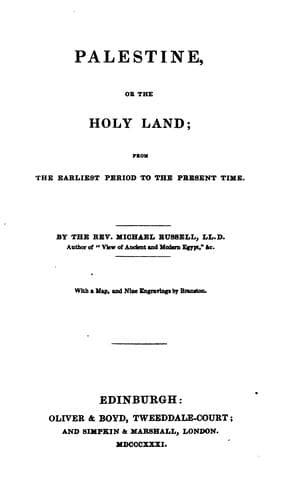
Palestine, or, the Holy Land: From the Earliest Period to the Present TimeRussell, Michael
History
Palestine, or, the Holy Land: From the Earliest Period to the Present Time
Russell, Michael
Palestine -- Description and travel; Palestine -- History
In a country where there are so many traces of volcanic action, the rocks
of the lower levels cannot fail to bear marks of their origin.
Hasselquist relates, that the Hill of Tiberias, out of which issues the
fountain whence the baths are supplied, consists of a black and brittle
sulphurous stone, which is only to be found in large masses in the
neighborhood, though it is commonly met with in rolled specimens on the
shores of the Dead Sea, and in other parts of the valley. The sediment
deposited by the water is also black, as thick as paste, smells strongly
of sulphur, and is covered with two skins or cuticles, of which the lower
is of a fine dark-green, and the uppermost of a light rusty colour. At
the mouth of the outlet, where the stream formed little cascades over the
stones, the first cuticle alone was found, and so much resembled a
conferva, that one might have taken it for a vegetable production; but
nearer the river, where the current became stagnant, both skins were
visible, the yellow on the surface, and under it the green.[188]
There are observed, in the same hollow, small portions of quartz
incrusted with an impure salt, and nodules of clay extremely compact.
Near the edge of the valley there lie scattered on the sand considerable
portions of flinty slate; and amid the common clay, which forms the basis
of the soil, are perpendicular layers of a lamellated brown argil,
assuming, as it were, the slaty structure. Dr. Clarke noticed among the
pebbles near the Lake of Tiberias pieces of a porous rock resembling the
substance called toadstone in England; its cavities were filled with
zeolite. Native gold was likewise found there, but the quantity was so
small as not to draw from the travellers a suitable degree of attention.
The Vale of the Asphaltites is further remarkable for a species of
limestone called the fetid, the smell of which, as its name imports, is
extremely offensive. It is still manufactured in the East into amulets,
and worn as a specific against the plague; and that a similar
superstition existed in regard to this stone in very early ages is
rendered manifest by the circumstance, that charms made of the same
substance were found in the subterranean chambers under the pyramids of
Sakhara in Upper Egypt. The cause of the fetid effluvia emitted from this
rock, when partially decomposed by means of friction, is now known to be
connected with the presence of sulphuretted hydrogen. All bituminous
limestone, however, does not possess this property. It is not uncommon in
the calcareous beds called in England black marble, but it is by no means
their characteristic. The fragments obtained in the valley of the Jordan
have this savour in a high degree; and it is admitted that the oriental
limestone is more highly impregnated with hydrosulphuret than any
hitherto found in Europe.[189]
Public-domain text, read in full here on John Shaqi.
Reviews
Reviews
No reviews yet
Be the first to share your thoughts on this work.
Elsewhere in the archive
Join the Discussion
Join the discussion
Sign in to leave a comment or review.
Sign InorCreate an account