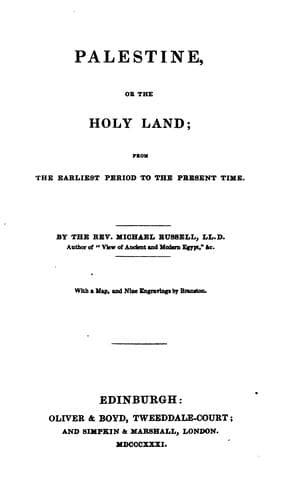
Palestine, or, the Holy Land: From the Earliest Period to the Present TimeRussell, Michael
History
Palestine, or, the Holy Land: From the Earliest Period to the Present Time
Russell, Michael
Palestine -- Description and travel; Palestine -- History
According to Dr. Shaw, the upper strata of rocks on the hills along the
coast are composed of a soft chalky substance, including a great variety
of corals, shells, and other marine exuviae. Upon the Castravan
mountains, near Beirout, there is a singular bed, consisting likewise of
a whitish stone, but of the slate-kind, which unfolds in every flake of
it a great number and variety of fishes. These, for the most part, lie
exceedingly flat and compressed, like the fossil specimens of fern; yet
are, at the same time, so well preserved, that the smallest lineaments
and fibres of their fins, scales, and other specific properties of
structure are easily distinguished. Among these were some individuals of
the squilla tribe, which, though one of the tenderest of the crustaceous
family, had not suffered the least injury from pressure or friction. The
heights of Carmel, too, present similar phenomena. In the chalky beds
which surround its summit are gathered numerous hollow flints, lined in
the inside with a variety of sparry matter, and having some resemblance
to petrified fruit. These are commonly bestowed upon pilgrims, not only
as curiosities, but as antidotes against several distempers. Those which
bear a likeness to the olive, usually denominated "lapides Judaici," are
looked upon, when dissolved in the juice of lemons, as an approved
medicine for curing the stone and gravel,--a specific, we may presume;
which, after the fashion of many others, operates upon the body through
the power of the imagination.[190]
Public-domain text, read in full here on John Shaqi.
Reviews
Reviews
No reviews yet
Be the first to share your thoughts on this work.
Elsewhere in the archive
Join the Discussion
Join the discussion
Sign in to leave a comment or review.
Sign InorCreate an account