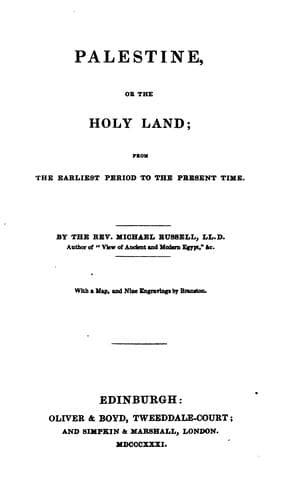
Palestine, or, the Holy Land: From the Earliest Period to the Present TimeRussell, Michael
History
Palestine, or, the Holy Land: From the Earliest Period to the Present Time
Russell, Michael
Palestine -- Description and travel; Palestine -- History
upon the earth; and unto them was given power, as the scorpions of the
earth have power. And they had tails like unto scorpions; and there were
stings in their tails: and their power was to hurt men five months."[203]
We ought not to be surprised that the translators of the English Bible
were occasionally at a loss to distinguish the genera and species of the
several animals mentioned in the Sacred Writings; for even at the present
day, when we possess infinitely higher advantages in point of natural
knowledge, we cannot precisely determine even the class or order to which
some of them belong. We have an example of this obscurity in the fourth
chapter of the book of Lamentations, where it is said that "even the
sea-monsters draw out the breast, they give suck to their young ones."
The original expression, tannin, appears applicable to those amphibious
animals that haunt the banks of rivers and the shores of the sea, and was
probably used by the prophet with a reference to the seal species, which
suckle their young in the manner described in his pathetic elegy.
It is true, that it is used in Genesis in connection with the epithet
large, and is therefore not improperly rendered "great whales." Hence it
has been concluded, that the word tannin may comprehend the class of
lizards from the eft to the crocodile, provided they be amphibious; also
the seal, the manati, the morse, and even the whale, if he came ashore;
but as whales remain constantly in the deep, they seem to be more
correctly ascribed to the class of fishes. Moreover, whether the people
of Syria had any knowledge of the whale kinds, strictly so called, is a
point which deserves inquiry before it be admitted as certain. At all
events, it is manifest that the tannin of the Scripture must have
indicated an animal which has many properties common to the seal, for it
not only applies the breast to its young, but has the power of exerting
its voice in a mournful tone. The prophet Micah says, "I will make a
wailing like the tanninim," a phrase which, in our translation, is
unhappily rendered "dragons." It has also the faculty of suspending
respiration, or of drawing in a quantity of breath and of emitting it
with violence. "The wild asses," says Jeremiah, "stand upon the high
places; they puff out the breath like the tanninim (here again translated
dragons); their eyes fail because there is no grass." On the whole,
remarks the editor of Calmet, we may consider the Hebrew _tahash_ as
being decidedly a seal; but tannin as including creatures resident both
on land and in water, or, in other words, the amphibia.[204]
SECTION VI.--FRUITS AND PLANTS.
Public-domain text, read in full here on John Shaqi.
Reviews
Reviews
No reviews yet
Be the first to share your thoughts on this work.
Elsewhere in the archive
Join the Discussion
Join the discussion
Sign in to leave a comment or review.
Sign InorCreate an account