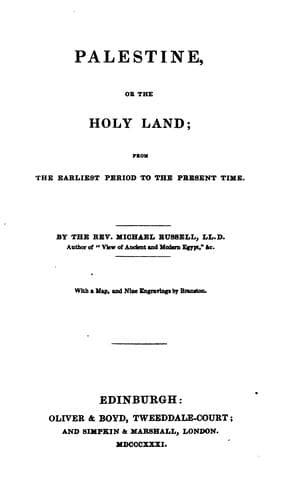
Palestine, or, the Holy Land: From the Earliest Period to the Present TimeRussell, Michael
History
Palestine, or, the Holy Land: From the Earliest Period to the Present Time
Russell, Michael
Palestine -- Description and travel; Palestine -- History
It has been remarked that, if the advantages of nature were duly seconded
by the efforts of human skill, we might in the space of twenty leagues
bring together in Syria the vegetable riches of the most distant
countries. Besides wheat, rye, barley, beans, and the cotton-plant, which
are cultivated everywhere, there are several objects of utility or
pleasure, peculiar to different localities. Palestine, for example,
abounds in sesamum, which affords oil; and in dhoura, similar to that of
Egypt. Maize thrives in the light soil of Balbec, and rice is cultivated
with success along the marsh of Haoul_. Within these twenty-five years
sugar-canes have been introduced into the gardens of Saida and Beirout,
which are not inferior to those of the Delta. Indigo grows without
culture on the banks of the Jordan, and only requires a little care to
secure a good quality. The hills of Latakie produce tobacco, which
creates a commercial intercourse with Damietta and Cairo. This crop is at
present cultivated in all the mountains. The white mulberry forms the
riches of the Druses, by the beautiful silks which are obtained from it;
and the vine, raised on poles or creeping along the ground, furnishes red
and white wines equal to those of Bordeaux. Jaffa boasts of her lemons
and watermelons; Gaza possesses both the dates of Mecca and the
pomegranates of Algiers. Tripoli has oranges which might vie with those
of Malta; Beirout has figs like Marseilles, and bananas like St. Domingo.
Aleppo is unequalled for pistachio-nuts; and Damascus possesses all the
fruits of Europe; inasmuch as apples, plums, and peaches, grow with equal
facility on her rocky soil. Niebuhr is of opinion that the Arabian
coffee-shrub might be cultivated in Palestine.[205]
The _fig-tree_, the _palm_, and the _olive_, are characteristic of the
Holy Land, and therefore deserve our more particular attention. In regard
to the first, the earliest fruit produced, which is usually ripe in June,
is called the boccore; the later, or proper fig, being rarely fit to be
gathered before the month of August. The name of these last is the
kermez, or kermouse. They constitute the article which passes through the
hands of the merchant, after being either preserved in the common way or
made up into cakes. They continue a long time on the tree before they
fall off; whereas the boccore drop as soon as they are ripe, and
according to the beautiful allusion of the prophet Nahum, "fall into the
mouth of the eater upon being shaken."
Public-domain text, read in full here on John Shaqi.
Reviews
Reviews
No reviews yet
Be the first to share your thoughts on this work.
Elsewhere in the archive
Join the Discussion
Join the discussion
Sign in to leave a comment or review.
Sign InorCreate an account