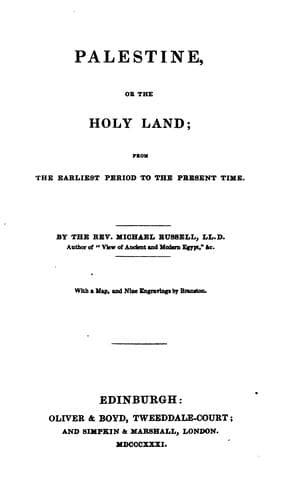
Palestine, or, the Holy Land: From the Earliest Period to the Present TimeRussell, Michael
History
Palestine, or, the Holy Land: From the Earliest Period to the Present Time
Russell, Michael
Palestine -- Description and travel; Palestine -- History
[117] The reading in Hasselquist must be _eighteen_ instead of eight, or
eight fathoms, instead of feet, for Mr. Maundrell remarks that the breadth
of the river "might be about twenty yards over, and in depth it far
exceeded my height."--_Journey_, p. 83.
[118] Deut. xxxiv. 1-7.
[119] 2 Kings ii. 19-23.
[120] Paradise Regained, Book I. v. 295, &c.
[121] Among these he found, with great delight, a very curious new cimex
or _bug_, p. 129.
[122] Journey, p. 80.
[123] Paradise Regained, Book II. v. 281.
[124] A Visit to Egypt, &c. p. 285.
[125] Travels of Ali Bey, vol. ii. p. 251.
[126] The Mussulmans say prayers in all the holy places consecrated to the
memory of Jesus Christ and the Virgin except the Tomb of the Holy
Sepulchre, which they do not acknowledge. They believe that Jesus Christ
did not die, but that he ascended alive into heaven, leaving the likeness
of his face to Judas, who was condemned to die for him; and that, in
consequence, Judas having been crucified, his body might have been
contained in this sepulchre, but not that of Jesus Christ. It is for this
reason that the Mussulmans do not perform any acts of devotion at this
monument, and that they ridicule the Christians who go to revere it--_Ali
Bey_, vol. ii. p. 237.
[127] Chateaubriand. Itinéraire, tom. ii. p. 169.
[128] Journey, p. 76.
[129] Pausanius, describing the Sepulchre of Helena at Jerusalem, mentions
this device: "It was so contrived that the door of the sepulchre, which
was of stone, and similar in all respects to the sepulchre itself, could
never be opened except upon the return of the same day and hour in each
succeeding year. It then opened of itself by means of the mechanism alone,
and after a short interval closed again. Such was the case at the time
stated; had you tried to open it at any other time, you would not have
succeeded, but broken it first in the attempt." Paus. in Arcad. cap.
xvi.--_Clarke's Travels_, vol. iv. p. 383.
[130] Journey, p. 63.
[131] Deut. xi. 29, 30.
[132] "Then cometh he to a city of Samaria, which is called Sychar, near
to the parcel of ground that Jacob gave to his son Joseph. Now Jacob's
Well was there."--John iv. 5, 6.
[133] Travels, vol. iv. p. 264.
[134] Clarke, vol. iv. p. 275.
[135] Clarke, vol. iv. p. 280.
[136] Richardson, vol. ii. p. 415.
[137] Travels in Palestine, &c. by J.S. Buckingham, vol. ii. p. 144.
[138] Travels in Palestine, vol. ii. p. 104.
[139] Num. xxi. 24. Deut. ii.
[140] Buckingham, vol. ii. p. 244.
[141] Travels in Palestine, p. 259.
[142] Buckingham, vol. ii. p. 261.
[143] Travels in Palestine, vol. ii. p. 261.
[144] Joseph, lib. iii. De Bell. Jud. Hasselquist, p.157. Clarke, iv.
p.227.
Public-domain text, read in full here on John Shaqi.
Reviews
Reviews
No reviews yet
Be the first to share your thoughts on this work.
Elsewhere in the archive
Join the Discussion
Join the discussion
Sign in to leave a comment or review.
Sign InorCreate an account