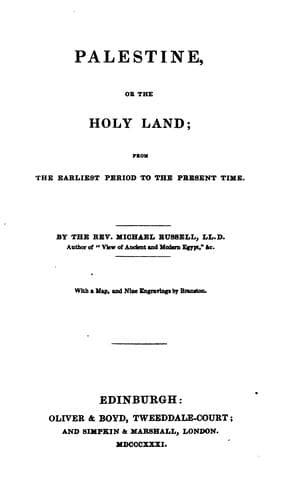
Palestine, or, the Holy Land: From the Earliest Period to the Present TimeRussell, Michael
History
Palestine, or, the Holy Land: From the Earliest Period to the Present Time
Russell, Michael
Palestine -- Description and travel; Palestine -- History
The topographical description of the holy Land is drawn from the works of
the long series of travellers and pilgrims, who, since the time of the
faithful Doubdan, have visited the interesting scenes where the Christian
Faith had its origin and completion. On this subject Maundrell is still a
principal authority; for, while we have the best reason to believe that he
recorded nothing but what he saw, we can trust implicitly to the accuracy
of his details in describing every thing which fell under his observation.
The same high character is due to Pococke and Sandys, writers whose
simplicity of style and thought afford a voucher for the truth of their
narratives. Nor are Thevenot, Paul Lucas, and Careri, though less
frequently consulted, at all unworthy of confidence as depositaries of
historical fact. In more modern times we meet with equal fidelity,
recommended by an exalted tone of feeling, in the volumes of Chateaubriand
and Dr. Richardson. Clarke, Burckhardt, Buckingham, Legh, Henniker,
Jowett, Light, Macworth, Irby and Mangles, Carne, and Wilson, have not
only contributed valuable materials, but also lent the aid of their names
to correct or to conform the statements of some of the more apocryphal
among their predecessors.
The chapter on Natural History has no pretensions to scientific
arrangement or technical precision in its delineations. On the contrary,
it is calculated solely for the common reader, who would soon be disgusted
with the formal notation of the botanist, and could not understand the
learned terms in which the student of zoology too often finds the
knowledge of animal nature concealed. Its main object is to illustrate the
Scriptures, by giving an account of the quadrupeds, birds, serpents,
plants, and fruits which are mentioned from time to time by the inspired
writers of either Testament.
Edinburgh, _September_, 1831.
CONTENTS.
CHAPTER I.
INTRODUCTORY OBSERVATIONS.
Interest attached to the History of Palestine; Remarkable Character of
the Hebrew People; Their small Beginning and astonishing Increases; The
Variety of Fortune they underwent; Their constant Attachment to the
Promised Land; The Subject presents an interesting Problem to the
Historian and Politician; The Connexion with Christianity; Effect of this
Religion on the Progress of Society; Importance of the Subject to the
pious Reader; Holy Places; Pilgrims; Grounds for Believing the Ancient
Traditions on this Head; Constantine and the Empress Helena; Relics;
Natural Scenery; Extent of Canaan; Fertility; Geographical Distribution;
Countries Eastward of the Jordan; Galilee; Samaria; Bethlehem; Jericho;
The Dead Sea; Table representing the Possessions of the Twelve Tribes.
CHAPTER II.
HISTORY OF THE HEBREW COMMONWEALTH.
Public-domain text, read in full here on John Shaqi.
Reviews
Reviews
No reviews yet
Be the first to share your thoughts on this work.
Join the Discussion
Join the discussion
Sign in to leave a comment or review.
Sign InorCreate an account