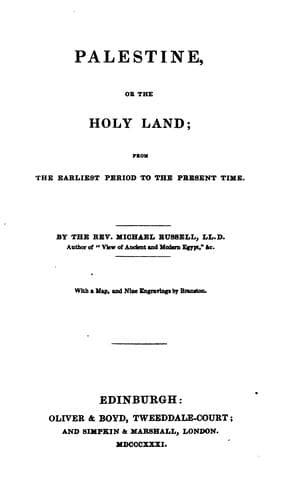
Palestine, or, the Holy Land: From the Earliest Period to the Present TimeRussell, Michael
History
Palestine, or, the Holy Land: From the Earliest Period to the Present Time
Russell, Michael
Palestine -- Description and travel; Palestine -- History
of mind, united with the gross manners and fierce passions of barbarians.
We applaud their patriotism, admire their courage and talent to the field,
and even share in the delight which accompanied their triumphs; yet, when
we return to their dwellings, we dare not inspect too narrowly the usages
of their domestic day, nor examine into the indulgences with which they
sometimes thought proper to remunerate the ails and cares of their public
life. Divine Wisdom, stooping to the imperfection of human nature,
employed the instruments that were best fitted for the gracious ends
which, by their means, were about to be accomplished; though it does not
appear to have been intended that mankind should ever resort to the
history of the Judges for lessons of decorum, humanity, or virtue.
CHAPTER III.
_Historical Outline from the Accession of Saul to the Destruction
of Jerusalem_.
Weakness of Republican Government; Jealousy of the several Tribes;
Resolution to have a King; Rules for regal Government; Character of
Saul; of David; Troubles of his Reign; Accession of Solomon; Erection
of the Temple; Commerce; Murmurs of the People; Rehoboam; Division of
the Tribes; Kings of Israel; Kingdom of Judah; Siege of Jerusalem;
Captivity; Kings of Judah; Return from Babylon; Second Temple; Canon of
Scripture; Struggles between Egypt and Syria; Conquest of Palestine by
Antiochus; Persecution of Jews; Resistance by the Family of Maccabaeus;
Victories of Judas; He courts the Alliance of the Romans; Succeeded by
Jonathan; Origin of the Asmonean Princes; John Hyrcanus; Aristobulus;
Alexander Jannaeus; Appeal to Pompey; Jerusalem taken by Romans; Herod
created King by the Romans; He repairs to the Temple; Archelaus succeeds
him, and Antipas is nominated to Galilee; Quirinius Prefect of Syria;
Pontius Pilate; Elevation of Herod Agrippa; Disgrace of Herod Philip;
Judea again a Province; Troubles; Accession of Young Agrippa; Felix;
Festus; Floris; Command given to Vespasian; War; Siege of Jerusalem by
Titus.
The weakness and jealousy which seem inseparable from a government
comprehending a number of Independent states, had been deeply felt
during the administration of Eli, and even under that of Samuel in
his latter days. Established in different parts of the country, the
several tribes were actuated by local interests and selfish views;
those in the north, who were exempted from the hostile inroads of the
hilistines and Ammonites, refusing to aid their brethren, the children
of Simeon and Judah, whose territory was constantly exposed to the
ravages of those warlike neighbours. In the time of the more recent
judges, the federal union on which the Hebrew commonwealth was founded
appeared practically dissolved. Nay, a spirit of rivalry and dissension
occasionally manifested itself among the kindred communities of which
it was composed;--Ephraim, stimulated by envy, vexed Judah, and Judah
vexed Ephraim.[33]
Public-domain text, read in full here on John Shaqi.
Reviews
Reviews
No reviews yet
Be the first to share your thoughts on this work.
Join the Discussion
Join the discussion
Sign in to leave a comment or review.
Sign InorCreate an account