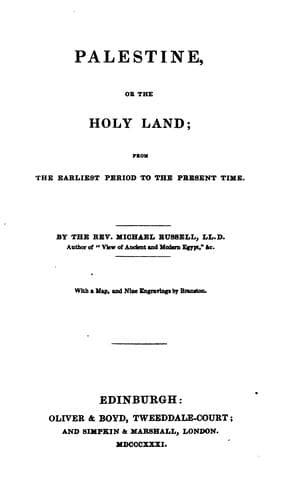
Palestine, or, the Holy Land: From the Earliest Period to the Present TimeRussell, Michael
History
Palestine, or, the Holy Land: From the Earliest Period to the Present Time
Russell, Michael
Palestine -- Description and travel; Palestine -- History
Meanwhile, several powerful kingdoms in the east, as well as the south,
threatened the independence of the Twelve Tribes, especially those on
the borders of the desert. Assyria had already turned her views towards
the fertile lands which skirt the shores of the Mediterranean; and
Egypt, in order to protect her rich valley from the aggressions of that
rising monarchy, began to open her eyes to the expediency of securing
the frontier towns in the nearest parts of Palestine. In a word, it was
fast becoming manifest that the existence of the Hebrews, as a free and
distinct people, could only be secured by reviving the union which had
originally subsisted among their leading families, under a form that
would combine their physical strength and patriotism in the support of
a common cause. An aged priest, although he might with the utmost
authority direct the solemnities of their national worship, and even
administer the laws to which they were all bound to submit, could not
command the secular obedience of rude clans, or, with any prospect of
success, lead them to battle against an enemy practised in all the
stratagems of war. The people, therefore, demanded the consent of Samuel
to a change in the structure of their government, that they might have a
king, not only to preside over their civil affairs, but also to go out
before them and fight their battles.[34]
The principal reason assigned by the elders of Israel for the innovation
which they required at the hands of their ancient prophet was, that they
might be "like all the nations;" evidently alluding to the advantages of
monarchical power, when decisive measures become necessary to defend the
interests of a state. It is remarkable that Moses had anticipated this
natural result in the progress of society, and even laid down rules for
the administration of the regal government. This wise legislator provided
that the king of the Hebrews should not be a foreigner: lest he might be
tempted to sacrifice the interest of his subjects to the policy of his
native land, and perhaps to countenance the introduction of unauthorized
rites into the worship of Jehovah. It was also stipulated that the
sovereign of the chosen people should not multiply horses to himself, lest
he should be carried by his ambition to make war in distant countries, and
neglect the welfare of the sacred inheritance promised to the fathers of
the Jewish nation.[35]
Public-domain text, read in full here on John Shaqi.
Reviews
Reviews
No reviews yet
Be the first to share your thoughts on this work.
Join the Discussion
Join the discussion
Sign in to leave a comment or review.
Sign InorCreate an account