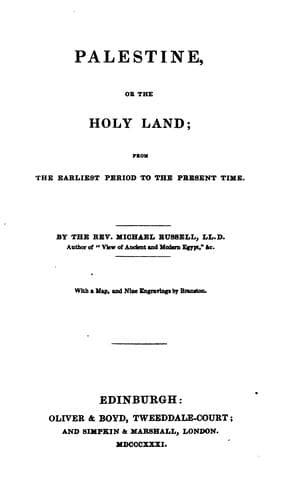
Palestine, or, the Holy Land: From the Earliest Period to the Present TimeRussell, Michael
History
Palestine, or, the Holy Land: From the Earliest Period to the Present Time
Russell, Michael
Palestine -- Description and travel; Palestine -- History
The qualities which recommended Saul to the choice of Samuel and the
approbation of the Tribes, leave no room for doubt that it was chiefly
as a military leader that the son of Kish was raised to the throne. Nor
was their expectation disappointed in the young Benjaminite, so far as
courage and zeal were required in conducting the affairs of war. But the
impetuosity of his character, and a certain indifference in regard to the
claims of the national faith, paved the way for his downfall and the
extinction of his family. The scene of Gilboa, which terminated the career
of the first Hebrew monarch, exhibits a most affecting tragedy; in which
the valour of a gallant chief, contrasted with his despair and sorrow,
throws a deceitful lustre over an event which the reader feels that he
ought to condemn.
David, to the skill of an experienced warrior, added a deep reverence for
the institutions of his country and the forms of Divine worship; whence he
procured the high distinction of being a man after God's own heart. To
this celebrated king was reserved the honour of taking from the Jebusites
a strong fortress on the borders of Judah and Benjamin, and of laying the
foundations of Jerusalem, viewed, at least, as the metropolis of Palestine
and the seat of the Hebrew government. On Mount Zion he built a suburb of
considerable beauty; and strength, which continued for many years to bear
his name, and to reflect the magnificence of his genius. Not satisfied
with this acquisition, he extended his arms on all sides, till the
borders of his kingdom touched the western bank of the Euphrates and the
neighbourhood of Damascus. He likewise defeated the Philistines, those
restless enemies of the southern tribes, and added their dominions to the
crown of Israel. The Moabites, who had provoked his resentment, were
subjected to military execution, and deprived of a large portion of their
land; an example of severity which, so far from intimidating the children
of Ammon, only provoked them to try the fortune of war against the
victorious monarch. David despatched an army under the command of the
irascible Joab, who, after worsting them in the field, inflicted a
tremendous chastisement upon the followers of Hanun, for having studiously
insulted the ambassadors of his master.[36]
Public-domain text, read in full here on John Shaqi.
Reviews
Reviews
No reviews yet
Be the first to share your thoughts on this work.
Join the Discussion
Join the discussion
Sign in to leave a comment or review.
Sign InorCreate an account