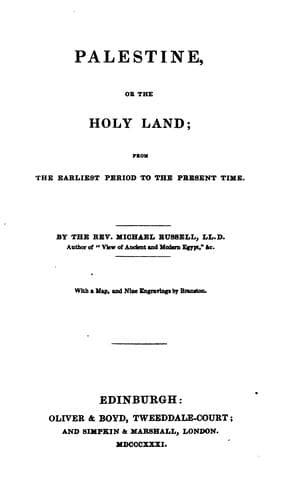
Palestine, or, the Holy Land: From the Earliest Period to the Present TimeRussell, Michael
History
Palestine, or, the Holy Land: From the Earliest Period to the Present Time
Russell, Michael
Palestine -- Description and travel; Palestine -- History
But the splendour of this reign was afterward clouded by domestic guilt
and treason; and the nation, which could now have defied the power of its
bitterest enemies, was divided and rendered miserable by the foul passions
that issued from the royal palace. Still, notwithstanding the rebellion of
Absalom, and the defection of certain military leaders, David bequeathed
to his successor a flourishing kingdom; rapidly advancing in the arts
of civilized life, enjoying an advantageous commerce, the respect of
neighbouring states, and a decided preponderance among the minor
governments of Western Asia. His last years were spent in making
preparations for the building of a temple at Jerusalem,--a work that he
himself was not allowed to accomplish, because his hands were stained with
blood, which, however justly shed, rendered them unfit for erecting an
edifice to the God of mercy and peace.[37]
The success which had attended the arms of his father rendered the
accession of Solomon tranquil and secure, so far, at least, as we
consider the designs of the surrounding nations. Accordingly; finding
himself in possession of quiet as well as of an overflowing treasury, he
proceeded to realize the pious intentions of David in regard to the
house of God, and thereby to obey the last commands which had been
imposed upon him before he had received the crown. The chief glory of
Solomon's administration identified with the erection of the Temple. Nor
were the advantages arising from this great undertaking confined to the
spiritual objects to which it was principally subservient On the
contrary, the necessity of employing foreign artists, and of drawing
part of his materials from a distance, suggested to the king the
benefits of a regular trade; and as the plains of Syria produced more
corn than the natives could consume, he supplied the merchants of Tyre
and the adjoining ports with a valuable commodity, in return for the
manufactured goods which his own subjects could not fabricate. It was in
his reign that the Hebrews first became a commercial people; and
although we must admit that considerable obscurity still hangs over the
tracks of navigation which were pursued by the mariners of Solomon,
there is no reason to doubt that his ships were to be seen on the
Mediterranean, the Red Sea, and the Persian Gulf.[38]
Public-domain text, read in full here on John Shaqi.
Reviews
Reviews
No reviews yet
Be the first to share your thoughts on this work.
Elsewhere in the archive
Join the Discussion
Join the discussion
Sign in to leave a comment or review.
Sign InorCreate an account