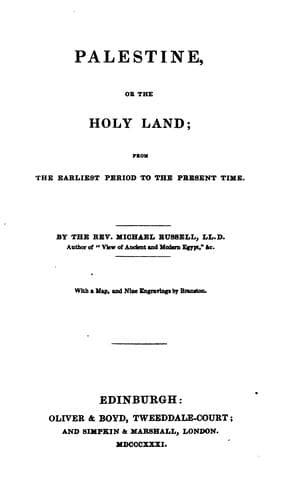
Palestine, or, the Holy Land: From the Earliest Period to the Present TimeRussell, Michael
History
Palestine, or, the Holy Land: From the Earliest Period to the Present Time
Russell, Michael
Palestine -- Description and travel; Palestine -- History
But the popularity of his government did not keep pace with the rapidity
of his improvements or the magnificence of his works. Perhaps the vast
extent of his undertakings may have led to unusual demands upon the
industry of his people, and given occasion to those murmurs which could
hardly be repressed even within the precincts of the court. Like his
predecessor, too, he occasionally failed to illustrate, in his own
conduct, the excellent precepts that he propounded for the direction of
others; and towards the close of his life, particularly, the wisdom of
his moral lessons was strongly contrasted with the practical follies
which stand recorded against him in the inspired narrative. He totally
disregarded the leading principles of the constitution constructed by
Moses and left for the guidance of all Hebrew kings; not only multiplying
horses even to the extent of maintaining a large body of cavalry, and
marrying many wives who turned away his heart, but proceeding so far as to
give his countenance to idolatrous worship within sight of the very Temple
which he had consecrated to Jehovah, the God of all the earth.[39]
It was in this reign that the limits of Jewish power attained their
utmost reach, comprehending even the remarkable district of Palmyrene, a
spacious and fertile province in the midst of a frightful desert. There
were in it two principal towns, Thapsacus and Palmyra, from the latter
of which the whole country took its name. Solomon, it is well known,
took pleasure to adding to its beauty and strength, as being one of his
main defences on the eastern border; and hence it is spoken of in
Scripture as Tadmor in the wilderness. Josephus calls it Thadamor; the
Seventy recognise it under the name of Theodmor and Thedmor; while the
Arabs and Syrians at the present day keep alive the remembrance of its
ancient glory as Tadmor, Tadmier, and Tatmor. But of Solomon's labours
not one vestige now remains. The inhabitants having revolted from the
Emperor Aurelian, and pledged their faith to an adventurer called
Antiochus, or Achilles, who had assumed the purple, this splendid
town was attacked and razed to the ground. Repenting of his hasty
determination, the Roman prince gave orders that Palmyra should be
immediately rebuilt; but so inefficient were the measures which he
adopted, or so imperfectly was he obeyed in their execution, that the
city in the desert has ever since been remarkable only as a heap of
magnificent ruins. The first object that now presents itself to the
traveller who approaches this forlorn place, is a castle of mean
architecture and uncertain origin, about half an hour's walk from it, on
the north side. "From thence," says Mr. Maundrell, "we descry Tadmor,
enclosed on three sides, by long ridges of mountains; but to the south
is a vast plain which bounds the visible horizon. The barren soil
presents nothing green but a few palm trees. The city must have been of
Public-domain text, read in full here on John Shaqi.
Reviews
Reviews
No reviews yet
Be the first to share your thoughts on this work.
Elsewhere in the archive
Join the Discussion
Join the discussion
Sign in to leave a comment or review.
Sign InorCreate an account