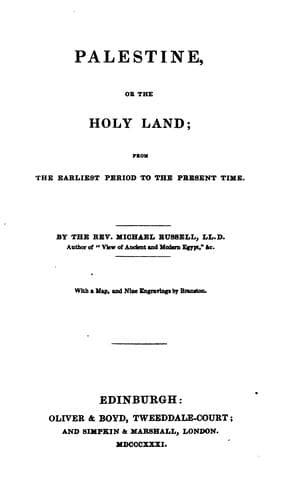
Palestine, or, the Holy Land: From the Earliest Period to the Present TimeRussell, Michael
History
Palestine, or, the Holy Land: From the Earliest Period to the Present Time
Russell, Michael
Palestine -- Description and travel; Palestine -- History
large extent, if we may judge from the space now taken up by the ruins;
but as there are no traces of its walls, its real dimensions and form
remain equally unknown. It is now a deplorable spectacle, inhabited by
thirty or forty miserable families, who have built huts of mud within a
spacious court which once enclosed a magnificent heathen temple."[40]
The despotism exercised by Solomon created a strong reaction, which was
immediately felt on the accession of his son Rehoboam. This prince,
rejecting the advice of his aged counsellors, and following that of the
younger and more violent, soon had the misfortune to see the greater
part of his kingdom wrested from him. In reply to the address of his
people, who entreated an alleviation of their burdens, he declared,
that instead of requiring less at their hands he should demand more.
"My father made your yoke heavy, I will add to your yoke; my father
chastised you with whips, but I will chastise you with scorpions." Such
a resolution, expressed in language at once so contemptuous and severe,
alienated from his government ten tribes, who sought a more indulgent
master in Jeroboam, a declared enemy of the house of David. Hence the
origin of the kingdom of Israel, as distinguished from that of Judah;
and hence, too, the disgraceful contentions between these kindred
states, which acknowledged one religion, and professed to be guided by
the same law. Arms and negotiation proved equally unavailing, in
repeated attempts which were made to reunite the Hebrews under one
sceptre; till, at length, about two hundred and seventy years after the
death of Solomon, the younger people were subdued by Shalmaneser, the
powerful monarch of Assyria, who carried them away captive into the
remoter provinces of his vast empire.[41]
Our plan does not admit a minuter detail of the sacred history than may
be readily found in the pages of the Old Testament. Suffice it therefore
to observe, that Jerusalem soon ceased to be regarded by the Israelites
as the centre of their religion, and the bond of union among the
descendants of Abraham.
Jeroboam had erected in his kingdom the emblems of a less pure faith, to
which he confined the attention of his subjects; while the frequent wars
that ensued, and the treaties formed on either side with the Gentile
nations on their respective borders, soon completed the estrangement
which ambition had begun. Little attached to the native line of princes,
the Israelites placed on the throne of Samaria a number of adventurers,
who had no qualities to recommend them besides military courage and an
irreconcilable hatred towards the more legitimate claimants of the house
of David. The following list will give a condensed view of the names,
the order, and the length of the reigns which belong to the sovereigns
of Israel, from the demise of Solomon down to the extinction of their
kingdom by the arms of Assyria:--
Public-domain text, read in full here on John Shaqi.
Reviews
Reviews
No reviews yet
Be the first to share your thoughts on this work.
Elsewhere in the archive
Join the Discussion
Join the discussion
Sign in to leave a comment or review.
Sign InorCreate an account