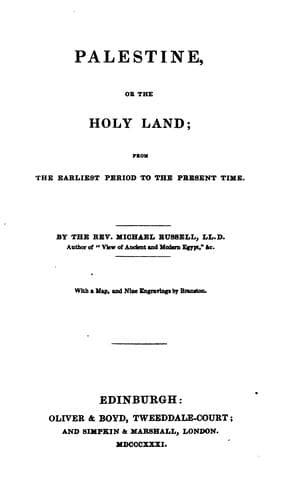
Palestine, or, the Holy Land: From the Earliest Period to the Present TimeRussell, Michael
History
Palestine, or, the Holy Land: From the Earliest Period to the Present Time
Russell, Michael
Palestine -- Description and travel; Palestine -- History
But Jonathan fell the victim of that refined policy to which he was
mainly indebted for his elevation. He left the sovereign priesthood to
his brother Simon, who, wisely abstaining from all interference in the
disputes which embroiled Egypt and Syria, directed his whole attention
to the improvement of the Jewish kingdom. To secure the tranquillity
which had been so dearly purchased he cultivated a more intimate connexion
with Rome; remitting, from time to time, such valuable tokens of his
respect as could not fail to make an impression on the venal minds of
those aspiring chiefs who already contended for the empire of the world
in that celebrated capital. But a conspiracy, originating in his own house,
and fomented by the agents of Antiochus, put an end to the life of Simon
and of his eldest son, who had earned considerable reputation in the
command of armies. The duty of avenging his death and of governing a
distracted country devolved upon his younger son, afterward well known
in history by the name of John Hyrcanus.
The unhappy circumstances under which he succeeded to power compelled him
to submit for a time to the condition of vassalage; but no sooner had
Antiochus Sidetes fallen in the Parthian war, than John shook off the yoke
of Syria, and exercised the rights of an independent sovereign. He even
extended his sway beyond the Jordan, reducing several important towns to
his obedience; though the achievement which most gratified his Jewish
subjects was the capture of Shechem, followed by the demolition of the
temple on Gerizim, so long regarded as the opprobrium of the Hebrew faith.
At a later period he made himself master of Samaria and Galilee, when, to
gratify still farther the vindictive grudge which yet rankled in the
breasts of his people, he destroyed the capital of the former, and debased
it to the condition of a stagnant lake. Nor was his attention confined to
foreign conquest. He strengthened the fortifications of Jerusalem, and
built the castle of Baris within the walls which surrounded the hill of
the Temple,--a stronghold, that at a future period attracted no small
degree of notice under the name of Antonia.
Public-domain text, read in full here on John Shaqi.
Reviews
Reviews
No reviews yet
Be the first to share your thoughts on this work.
Elsewhere in the archive
Join the Discussion
Join the discussion
Sign in to leave a comment or review.
Sign InorCreate an account