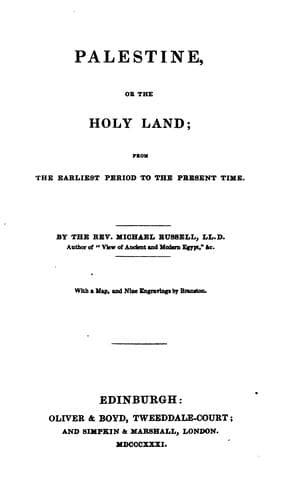
Palestine, or, the Holy Land: From the Earliest Period to the Present TimeRussell, Michael
History
Palestine, or, the Holy Land: From the Earliest Period to the Present Time
Russell, Michael
Palestine -- Description and travel; Palestine -- History
The government was enjoyed during a brief space by Aristobulus, the son of
Hyrcanus, whose reign was only distinguished by the most painful domestic
calamities. The throne was next occupied by Alexander Jannaeus, a man of
ignoble birth, but of a warlike and very ambitious temper. The distracted
state of the neighbouring countries induced him to take the field, with
the view of reducing several towns on the coast of the Mediterranean,--an
undertaking which finally involved him in the troubled politics of Egypt
and Cyprus. In process of time, the severity of his measures, or the
meanness of his extraction, rendered him so unpopular at Jerusalem that
the inhabitants expelled him by force of arms. A civil war of the most
sanguinary nature raged several years, during which the insurgents invited
the assistance of Demetrius Euchaerus, one of the kings of Syria. This
measure seems to have united a large party of Jews, who were equally
hostile to the dominant faction within the city, and to the ally whom they
had called to their aid. Alexander, after having repeatedly suffered the
heaviest losses, saw himself again at the head of a powerful army, with
which he resolved to march against the rebellious capital. He inflicted a
signal punishment upon such of the unfortunate citizens as fell into his
hands; ordering nearly a thousand of them to be crucified, and their wives
and children to be butchered before their eyes.
Having fully re-established his power to the remotest parts of Palestine,
the victorious high-priest, now drawing towards the close of his days,
gave instructions to his wife for the future government of the country.
Alexandria, a woman of a vigorous mind, held the reins of civil power
with great steadiness, while her eldest son, Hyrcanus the Second, was
decorated with the sacred diadem as the head of the nation. But, unhappily,
the commotions which had disturbed the reign of her husband were again
excited, and once more divided the people into two furious parties.
Aristobulus, the younger son of Jannaeus, gave his countenance to the
body who opposed his brother, and at length threw off his disguise so
completely as to aspire to supreme power in defiance of the rights of
birth and of a legal investiture. Hyrcanus, who was far inferior to his
ambitious relative in point of talent and resolution, would probably,
after the death of their mother, have been unable to keep his seat on the
throne, had he not received the powerful aid of Antipatar, a son of
Antipas, the governor of Idumea. Both sides were making preparation for an
appeal to arms, when the Romans, who had already overrun the finest parts
of Syria, advanced into the province of Palestine in the character at once
of umpires and of allies.
Public-domain text, read in full here on John Shaqi.
Reviews
Reviews
No reviews yet
Be the first to share your thoughts on this work.
Elsewhere in the archive
Join the Discussion
Join the discussion
Sign in to leave a comment or review.
Sign InorCreate an account