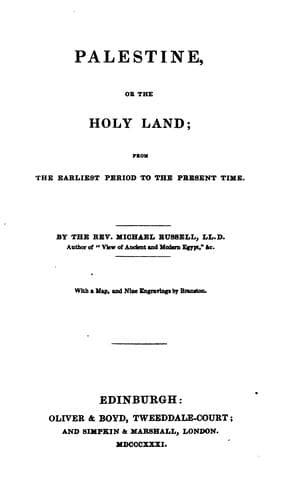
Palestine, or, the Holy Land: From the Earliest Period to the Present TimeRussell, Michael
History
Palestine, or, the Holy Land: From the Earliest Period to the Present Time
Russell, Michael
Palestine -- Description and travel; Palestine -- History
There is no subject on which greater obscurity prevails than that of the
learning and schools of the Hebrews prior to their return from the
Babylonian Captivity. The wise institution of Moses, which provided for
the maintenance of Levitical towns in all the tribes, secured at least an
hereditary knowledge of the law, including both its civil and its
spiritual enactments. It is extremely probable, therefore, that all the
varieties of literary attainment which might he deemed necessary, either
for the discharge of professional duties or for the ornament of private
life, were derived from those seminaries, and partook largely of their
general character and spirit. An examination of the scanty remains of that
remote period will justify, to a considerable extent, the conjecture now
made. It will appear that the poetry, the ethics, the oratory, the music,
and even the physical science cultivated in the time of Samuel and David
bore a close relation to the original object of the Levitical colleges,
and were meant to promote the principles of religion and morality, no less
than of that singular patriotism which made the Hebrew delight in his
separation from all other nations of the earth.
Our attention is first attracted by the several allusions which are
scattered over the earlier books of the Old Testament to the schools of
the prophets. These were establishments obviously intended to prepare
young men for certain offices analogous to those which are discharged in
our days by the different orders of the clergy; maintained in some degree
at the public expense; and placed under the superintendence of persons who
were distinguished for their gravity and high endowments. The principal
studies pursued in these convents appear to have been poetry and music,
the elements of which were necessary to the young prophet when he was
called to take a part in the worship of Jehovah. In the book of Samuel we
find the pupils performing on psalteries, tabrets, and harps; and in the
first section of the Chronicles it is said that the sons of Asaph, of
Heman, and of Jeduthan prophesied with harps, with psalteries, and with
cymbals. For the same reason Miriam the sister of Moses is called a
prophetess. When preparing to chant her song of triumph, upon the
destruction of the Egyptians at the Red Sea, "she took a timbrel in her
hand, and all the women went out after her with timbrels and with dances."
Public-domain text, read in full here on John Shaqi.
Reviews
Reviews
No reviews yet
Be the first to share your thoughts on this work.
Elsewhere in the archive
Join the Discussion
Join the discussion
Sign in to leave a comment or review.
Sign InorCreate an account