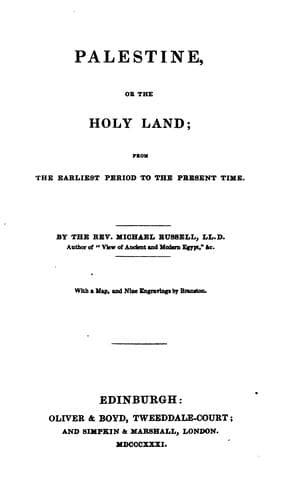
Palestine, or, the Holy Land: From the Earliest Period to the Present TimeRussell, Michael
History
Palestine, or, the Holy Land: From the Earliest Period to the Present Time
Russell, Michael
Palestine -- Description and travel; Palestine -- History
On a similar ground is the expression to be interpreted when used by St.
Paul in the eleventh chapter of his First Epistle to the Corinthians.
"Every woman praying or prophesying with her head uncovered dishononreth
her head;" that is, every female who takes a part in the devotions of the
Christian Church,--the supplications and the praises,--ought, according to
the practice of eastern nations, to have her face concealed in a veil, as
becoming the modesty of her sex in a mixed congregation. The term
prophesy, in this instance, must be restricted to the use of psalmody,
because exposition or exhortation in public was not permitted to the
women, who were not allowed to speak or even to ask a question in a place
of worship. Nay, the same apostle applies the title of prophet to those
persons among the heathen who composed or uttered songs in praise of their
gods. In his Epistle to Titus he alludes to the people of Crete in these
words, "one of themselves, even a prophet of their own, has said, the
Cretans were always liars." And every classical scholar is perfectly aware
that in the language of pagan antiquity a poet and a prophet were
synonymous appellations.
But the function of the prophet was not confined to the duty of praise and
thanksgiving; it also implied the ability to expound and enforce the
principles of the Mosaical Law. He was entitled to exhort and entreat; and
we accordingly find that the greater portion of the prophetical writings
consist of remonstrances, rebukes, threatenings, and expostulations. In
order to be a prophet, in the Hebrew sense of the expression, it was not
necessary to be endowed with the power of foreseeing future events. It is
true that the holy men through whom the Almighty thought meet to reveal
his intentions relative to the church, were usually selected from the
order of persons now described. But there were several exceptions, among
whom stood preeminent the eloquent Daniel and the pathetic Amos. To
prophesy, therefore, in the later times of the Hebrew commonwealth meant
most generally the explication and enforcement of Divine truth--an import
of the term which was extended into the era of the New Testament, when the
more recondite sense of the phrase was almost entirely laid aside.
Public-domain text, read in full here on John Shaqi.
Reviews
Reviews
No reviews yet
Be the first to share your thoughts on this work.
Elsewhere in the archive
Join the Discussion
Join the discussion
Sign in to leave a comment or review.
Sign InorCreate an account