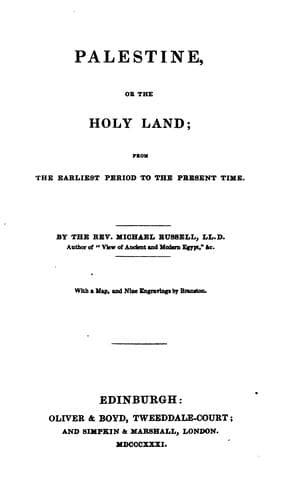
Palestine, or, the Holy Land: From the Earliest Period to the Present TimeRussell, Michael
History
Palestine, or, the Holy Land: From the Earliest Period to the Present Time
Russell, Michael
Palestine -- Description and travel; Palestine -- History
It may not appear out of place to inform the young reader that the
prophets whose writings are contained in the Old Testament are in number
sixteen, and usually divided into two classes, the greater and the minor,
according to the extent of their works and the importance of their
subject. Of the former, Isaiah, who may be regarded as the chief, began to
prophesy under Uzziah, and continued till the first year of Manasseh.
Jeremiah flourished a few years before the great captivity, and lived to
witness the fulfilment of his own predictions. Ezekiel, who had been
carried into the Babylonian territory some time before the ruin of his
native country in the days of Zedekiah, began to perform his office among
the Jewish captives in the land of the Chaldees, in the fifth year after
Jehoiakim was made prisoner. Daniel, the youngest of the four, was only
twelve years of age when he was involved in the miseries of conquest, and
reduced to the condition of a dependent at a foreign court.
Among the twelve minor prophets, Jonas, Hosea, Amos, and Micah preceded
the destruction of the kingdom of Israel. Nahum and Joel appeared between
that catastrophe and the captivity of Judah. Habakkuk, Obadiah, and
Zephaniah lived at the time when Jerusalem was taken, and during part of
the captivity. Haggai, Zecharias, and Malachi, the last of the whole,
prophesied after the return from Babylon.
But our business is rather with the literature of the prophets at large
than with the special functions of the few individuals of their body who
were commissioned by Heaven to reveal the secrets of future time. Of the
fruits of their professional study we have fine examples preserved in the
Psalms of David and the Proverbs of Solomon; the former, a collection of
sacred lyrics composed for the worship of Jehovah; the latter, a compend
of practical wisdom, suggested by an enlightened experience, and expressed
in language equally striking for its divine truth and rare simplicity.
In early times the dictates of moral philosophy are enounced in short
sentences, the result of much thought, and of which the effect is usually
heightened by the introduction of a judicious antithesis both in the
sentiment and the expression. The apothegms ascribed to the wise men of
Greece belong to this kind of composition; being extremely valuable to a
rude people who can profit by the fruits of reasoning without being able
to attend to its forms, and deposite in their minds a useful precept,
unencumbered with the arguments by means of which its soundness might be
proved. The books which bear the name of Solomon are distinguished above
all others for the sage views that they exhibit of human life, and for the
sensible maxims addressed to all conditions of men who have to encounter
its manifold perils--proving a guide unto the feet and a lamp unto the
path.
Public-domain text, read in full here on John Shaqi.
Reviews
Reviews
No reviews yet
Be the first to share your thoughts on this work.
Elsewhere in the archive
Join the Discussion
Join the discussion
Sign in to leave a comment or review.
Sign InorCreate an account