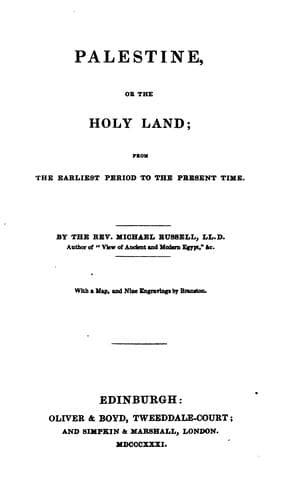
Palestine, or, the Holy Land: From the Earliest Period to the Present TimeRussell, Michael
History
Palestine, or, the Holy Land: From the Earliest Period to the Present Time
Russell, Michael
Palestine -- Description and travel; Palestine -- History
It is worthy of notice, too, that the prediction which gave so much
offence was conditional and contingent, and that Jeremiah, accordingly,
incurred the hazard of suffering the severe punishment due to a false
prophet; because if the people had turned from their sins the fate of
their capital and nation would have been protracted. "The Lord sent me to
prophesy against this house, and against this city, all the words that ye
have heard. Therefore now amend your ways and your doings, and obey the
voice of the Lord your God; and the Lord will repent him of the evil that
he hath pronounced against you. As for me, behold, I am in your hand; do
with me as seemeth good and meet unto you: but know ye for certain, that,
if ye put me to death, ye shall surely bring innocent blood upon
yourselves, and upon this city, and upon the inhabitants thereof; for of a
truth the Lord hath sent me unto you, to speak all these words in your
ears."[53]
The decision of the princes was more equitable than the accusation adduced
by the priests and prophets; for according to the law of Moses no man
could be punished for predicting the most calamitous events, provided he
persevered in the assertion that he spoke in the name of Jehovah. The
divine legislator denounced the penalty of death against every prophet who
should speak in the name of any false god, or who should speak in the name
of Jehovah that which he was not commanded to speak; but, in regard to the
latter offence, the guilt could only be substantiated by the failure of
the prophecy. "And if thou say in thine heart, how shall we know the word
which the Lord hath not spoken? When a prophet speaketh in the name of the
Lord, if the thing follow not, nor come to pass, that is the thing which
the Lord hath not spoken, but the prophet hath spoken it
presumptuously."[54]
It is obvious, however, that in all cases where a condition was implied,
the fulfilment of the prediction could not be regarded as essential to the
establishment of the prophetic character. The capture of Jerusalem
produced the most undeniable testimony to the inspiration of Jeremiah, as
well as to the sincerity of his expostulation; yet it is well known that
his motives did not escape suspicion, and that his memory was loaded by
many of his countrymen with the charge of having favoured the Chaldeans.
Public-domain text, read in full here on John Shaqi.
Reviews
Reviews
No reviews yet
Be the first to share your thoughts on this work.
Elsewhere in the archive
Join the Discussion
Join the discussion
Sign in to leave a comment or review.
Sign InorCreate an account