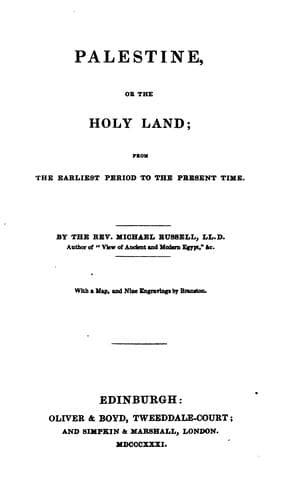
Palestine, or, the Holy Land: From the Earliest Period to the Present TimeRussell, Michael
History
Palestine, or, the Holy Land: From the Earliest Period to the Present Time
Russell, Michael
Palestine -- Description and travel; Palestine -- History
If I say, surely the darkness shall
cover me, even the night shall be turned into day. Yea, the darkness is no
darkness with thee, but the night shineth as the day: the darkness and the
light are both alike to thee."
A similar train of lofty conception pervades the writings of the prophets.
"Who hath measured the waters in the hollow of his hand, and meted out the
heavens with a span, and comprehended the dust of the earth in a measure,
and weighed the mountains in scales, and the hills in a balance? Behold,
the nations are as a drop of a bucket, and are counted as the small dust
of the balance; be taketh up the isles as a very little thing. It is he
that sitteth upon the circle of the earth, and the inhabitants thereof are
as grass-hoppers. Lift up your eyes on high, and behold who hath created
these things, who bringeth out their host by number: he calleth them all
by names, by the greatness of his might, for that he is strong in power,
no one faileth. Hast thou not known, hast thou not heard, that the
everlasting God, the Lord, the Creator of the ends of the earth; fainteth
not, neither is weary! There is no searching of his understanding."
The following quotation from the same inspired author is very striking,
inasmuch as the truth contained in it is founded upon an enlarged view of
the Divine government, and directly pointed against that insidious
Manicheism, which, originating in the East, has gradually infected the
religious opinions of a large portion of mankind. Light was imagined to
proceed from one source, add darkness from another; all good was traced do
one being, and all evil was ascribed to a hostile and antagonist
principle. Spirit, pure and happy, arose from the former; while matter,
with its foul propensities and jarring elements, took its rise from the
latter. But Isaiah, guided by an impulse which supersedes the inferences
of the profoundest philosophy, thus speaks concerning the God of the
Hebrews:--"I am the Lord, and there is none else; there is no God besides
me: I form the light, and create darkness; I make peace and create evil;
I, the Lord, do all these things."
But it is not only in such sublimity of language and exalted imagery that
the literature of the Hebrews surpasses the writings of the most learned
and ingenious portion of the heathen world. A distinction not less
remarkable is to be found in the humane and compassionate spirit which
animates even the earliest parts of the sacred volume; composed at a time
when the manners of all nations were still unrefined, and the softer
emotions were not held in honour. "Blessed is he who considereth the poor
and needy; the Lord will deliver him in the time of trouble. The Lord will
preserve him and keep him alive; he shall be blessed upon earth, and thou
wilt not deliver him into the will of his enemies. The Lord will
strengthen him upon the bed of languishing; thou wilt make all his bed in
his sickness."
Public-domain text, read in full here on John Shaqi.
Reviews
Reviews
No reviews yet
Be the first to share your thoughts on this work.
Elsewhere in the archive
Join the Discussion
Join the discussion
Sign in to leave a comment or review.
Sign InorCreate an account