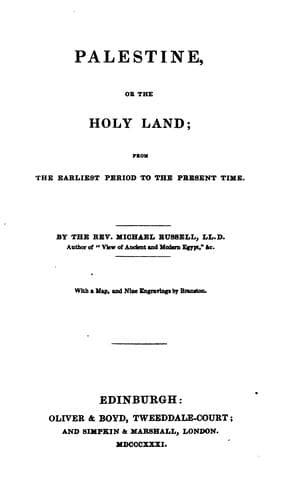
Palestine, or, the Holy Land: From the Earliest Period to the Present TimeRussell, Michael
History
Palestine, or, the Holy Land: From the Earliest Period to the Present Time
Russell, Michael
Palestine -- Description and travel; Palestine -- History
We shall in vain seek for instances of such a benign and liberal feeling
in the volumes of the most enlightened of pagan writers, whether poets or
orators. How beautifully does the following observation made by Solomon
contrast with the contempt expressed by Horace for the great body of his
countrymen:--"He that despiseth his neighbour sinneth; but he that bath
mercy on the poor happy is he. He that oppresseth the poor reproacheth his
Maker."
Among the Israelites there was no distinction as to literary privilege or
philosophical sectarianism. There was no profane vulgar in the chosen
people. The stores of Divine knowledge were open to all alike. The
descendant of Jacob beheld in every member of his tribe a brother, and not
a master; one who in all the respects which give to man dignity and
self-esteem was his equal in the strictest sense of the term. Hence the
noble flame of patriotism which glowed in all the Hebrew institutions
before the people became corrupted by idolatry and a too frequent
intercourse with the surrounding tribes; and hence, too, the still more
noble spirit of fraternal affection which breathed in their ancient law,
their devotional writers, and their prophets.
It is worthy of remark, that in order to prevent any part of the sacred
oracles from becoming obsolete or falling into oblivion, the inspired
lawgiver left an injunction to read the books which bear his name, in the
hearing of all the people, at the end of every seven years at farthest.
"And Moses wrote this law, and delivered it unto the priests, the sons of
Levi, which bare the ark of the covenant of the Lord, and unto all the
elders of Israel. And Moses commanded them, saying, At the end of every
seven years, in the solemnity of the year of release, in the feast of
tabernacles, when all Israel is come to appear before the Lord thy God in
the place which he shall choose, thou shaft read this law before all
Israel in their hearing. Gather the people together, men, and women, and
children, and thy stranger that is within thy gates, that they may hear,
and that they may learn, and fear the Lord your God, and observe to do all
the words of this law: and that their children which have not known any
thing may hear, and learn to fear the Lord your God, as long as ye live in
the land whither ye go over Jordan to possess it."[55]
Public-domain text, read in full here on John Shaqi.
Reviews
Reviews
No reviews yet
Be the first to share your thoughts on this work.
Elsewhere in the archive
Join the Discussion
Join the discussion
Sign in to leave a comment or review.
Sign InorCreate an account