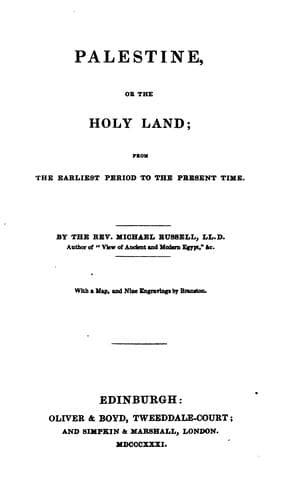
Palestine, or, the Holy Land: From the Earliest Period to the Present TimeRussell, Michael
History
Palestine, or, the Holy Land: From the Earliest Period to the Present Time
Russell, Michael
Palestine -- Description and travel; Palestine -- History
We have ascribed the cultivation of sacred knowledge to the schools of the
prophets, without having been able to trace very distinctly the
institution of these seminaries to the Levitical colleges, the proper
fountains of the national literature. In the days of Samuel, it would
appear that the necessity of certain subordinate establishments had been
admitted, in order to supply a class of persons qualified to instruct such
of the people as lived at a distance from the cities of the Levites. The
rule of the prophetical schools seems to have borne some resemblance to
that of the better description of Christian convents in the primitive
ages, enjoining abstinence and labour, together with an implicit obedience
to the authority of their superiors. The clothing, also, it may be
presumed, was humble, and somewhat peculiar. A rough garment fastened with
a girdle round the loins is alluded to by Zechariah; while the impression
made on the courtiers at Ramoth-gilead by the appearance of one of the
sons of the prophets sent thither by Elisha would lead us to the same
conclusion. "Wherefore," said they, "came this mad fellow to thee?" Nor is
it without reason that some authors have attributed the conduct of the
children who mocked Elieha to the uncouthness of his dress and to the want
of a covering for his head. Be this as it may, there is no doubt that from
the societies now mentioned sprang the most distinguished men who adorned
the happiest era of the Jewish church.
Were we allowed to form a judgment from the few incidents recorded in the
books of the Kings, we should conclude that the accomplishment of writing
was not very general among the subjects of David and Solomon. It is
ingeniously conjectured by Michaelis, that Joab, the captain of the host,
and sister's son of the inspired monarch himself, could not handle the
pen; else he would not, for the purpose of concealing from the bearer the
real object for which he was sent, have found it necessary to tax his
ingenuity by putting the very suspicious detail of Uriah's death into the
mouth of a messenger to be delivered verbally to the king. He would at
once have written to him that the devoted man was killed.[58]
Public-domain text, read in full here on John Shaqi.
Reviews
Reviews
No reviews yet
Be the first to share your thoughts on this work.
Elsewhere in the archive
Join the Discussion
Join the discussion
Sign in to leave a comment or review.
Sign InorCreate an account