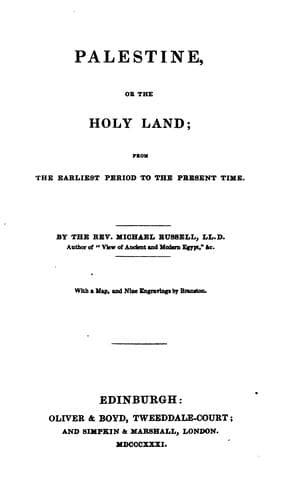
Palestine, or, the Holy Land: From the Earliest Period to the Present TimeRussell, Michael
History
Palestine, or, the Holy Land: From the Earliest Period to the Present Time
Russell, Michael
Palestine -- Description and travel; Palestine -- History
As to science in its higher branches, we can not expect any proofs of
eminence among a secluded people, devoted, as the Hebrews were, to the
pursuits of agriculture and the feeding of cattle. Solomon, indeed, is
said to have been acquainted with all the productions of nature, from the
cedar of Libanus to the hyssop on the wall; and we may readily believe,
that the curiosity which distinguished his temper would find some
gratification in the researches of natural history,--the first study of
the opening mind in the earliest stage of social life. But astronomy had
not advanced farther than to present an interesting subject of
contemplation to the pious mind, which could only regard the firmament as
a smooth surface spread out like a curtain, or bearing some resemblance to
the canopy of a spacious tent. The schools of the prophets, we may
presume, were still strangers to those profound calculations which
determine the distance, the magnitude, and the periodical revolutions of
the heavenly bodies. Even the sages of Chaldea, who boast a more ancient
civilization than is claimed by the Hebrews, satisfied themselves with a
few facts which they had not learned to generalize, and sometimes with
conjectures which had hardy any relation to a fixed principle or a
scientific object. Long after the reign of David, these wise men had not
distinguished the study of the stars from the dreams of astrology.
The first application of astronomical principle is to the division of
time, as marked out by the periodical movements of the heavenly bodies.
The Hebrews combined in their calculations a reference to the sun and to
the moon, so as to avail themselves of the natural measure supplied by
each. Their year accordingly was lunisolar, consisting of twelve lunar
months, with an intercalation to make the whole agree with the annual
course of the sun. The year was further distinguished as being either
common or ecclesiastical. The former began at the autumnal equinox, the
season at which they imagined the world was created; while the latter, by
Divine appointment, commenced about six months earlier, the period when
their fathers were delivered from the thraldom of Egypt. Their months
always began with the new moon; and before the captivity they were merely
named according to their order, the first, second, third, and so on down
to the twelfth. But upon their return they used the terms which they found
employed in Babylon, according to the following series:--
Nisan[59] March.
Zif, or Ijar April.
Sivan May.
Tamuz June.
Ab July.
Elul August.
Ethanim, or Tisri September.
Bul, or Mareshuan October.
Chisleu November.
Tebeth December.
Sebat January.
Adar February.
Public-domain text, read in full here on John Shaqi.
Reviews
Reviews
No reviews yet
Be the first to share your thoughts on this work.
Elsewhere in the archive
Join the Discussion
Join the discussion
Sign in to leave a comment or review.
Sign InorCreate an account