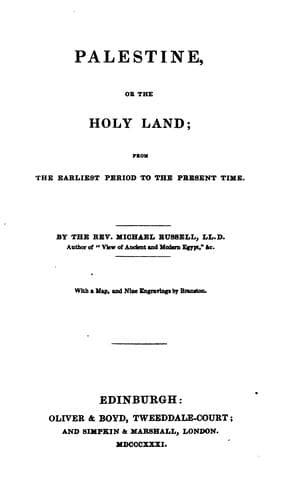
Palestine, or, the Holy Land: From the Earliest Period to the Present TimeRussell, Michael
History
Palestine, or, the Holy Land: From the Earliest Period to the Present Time
Russell, Michael
Palestine -- Description and travel; Palestine -- History
The termination of the vintage was marked with a similar expression of
thanksgiving, uttered by the assembled tribes in the place which had
received the "Name of Jehovah;" the visible manifestation of his presence
and power. The precept for this observance is given in the following
terms:--"On the fifteenth day of the seventh month, when ye have gathered
in the fruit of the land, ye shall keep a feast unto the Lord seven days.
And ye shall take unto you, on the first day, the boughs of goodly trees,
branches of palm-trees, and the boughs of thick trees and willows of the
brook; and ye shall rejoice before the Lord your God seven days. Ye shall
dwell in booths seven days, that your generations may know that I made the
children of Israel to dwell in booths when I brought them out of the land
of Egypt."
This festival was of the most lively and animated description, celebrated
with a joyous heart, and under the canopy of heaven, in a most delightful
season of the year. If more exquisite music and more graceful dances
accompanied the gathering in of the grapes on the banks of the Cephisus,
the tabret and the viol and the harp, which sounded around the walls of
the sacred metropolis, were not wanting in sweetness and gayety; and,
instead of the frantic riot of satyrs and bacchanals, the rejoicing was
chastened by the solemn religious recollections with which it was
associated, in a manner, remarkably pleasing and picturesque.[63]
The feast of Trumpets had a reference to the mode practised by many of the
ancients for announcing the commencements of seasons and epochs. The
beginning of every month was made known to the inhabitants of Jerusalem by
the sound of musical instruments. "Blow up the trumpet in the new moon, in
the time appointed, on our solemn feast-day: for this was a statute for
Israel, a law of the God of Jacob." As the first day of the moon in
September was the beginning of the civil year, the festivity was greater
and more solemn than on other occasions. The voice of the trumpets waxed
louder than usual, and the public mind was instructed by a grave assurance
from the mouth of the proper officer, that another year was added to the
age of the world. "In the seventh month, in the first day of the month,
shall ye have a Sabbath, a memorial of blowing of trumpets, an holy
convocation. Ye shall do no servile work therein; but ye shall offer an
offering made by fire unto the Lord."[64]
Public-domain text, read in full here on John Shaqi.
Reviews
Reviews
No reviews yet
Be the first to share your thoughts on this work.
Elsewhere in the archive
Join the Discussion
Join the discussion
Sign in to leave a comment or review.
Sign InorCreate an account