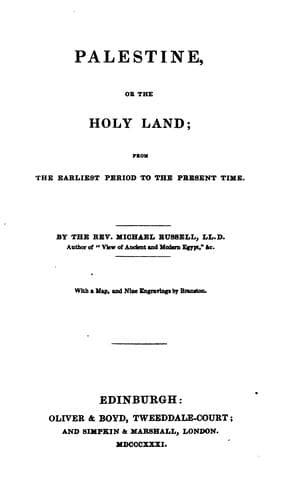
Palestine, or, the Holy Land: From the Earliest Period to the Present TimeRussell, Michael
History
Palestine, or, the Holy Land: From the Earliest Period to the Present Time
Russell, Michael
Palestine -- Description and travel; Palestine -- History
The proper preparation indeed of every festival began only at three
o'clock, called by the Hebrews the ninth hour, and continued till the
close of the day, or the disappearance of the sun. It was at that hour,
accordingly, that the Jews entreated the governor to take down the bodies
from the cross; holding it extremely improper that any token of a curse or
capital punishment should meet their eyes while making ready to kill the
paschal lamb.
The Feast of Pentecost was an annual offering of gratitude to Jehovah for
having blessed the land with increase. It took place fifty days after the
passover, and hence the origin of its name in the Greek version of our
Scriptures. Another appellation was applied to it--the Feast of Weeks--for
the reason assigned by the inspired lawgiver. "Seven weeks shall thou
number unto thee; beginning to number the seven weeks from such time as
thou puttest the sickle to the corn. And thou shalt keep the feast of
weeks unto the Lord thy God with a tribute of a free-will offering of
thine hand, in the place which Jehovah shall choose to place his name
there: And thou shall remember that thou wast a bondman in Egypt."[62]
This was a very suitable celebration in an agricultural society, where joy
is always experienced upon the gathering in of the fruits of the earth.
The Hebrews were especially desired on that happy occasion to contrast
their improved condition, as freemen reaping their own lands, with the
miserable state from which they had been rescued by the good providence of
Jehovah. The month of May witnessed the harvest-home of all Palestine in
the days of Moses, as well as in the present times; and no sooner was the
pleasant toil of filling their barns completed, than all the males
repaired to the holy city with the appointed tribute is their hands, and
the song of praise in their mouths. Jewish antiquaries inform us, that
there was combined with this eucharistical service a commemoration of the
wonders which took place at Mount Sinai, when the Lord condescended to
pronounce his law in the ears of his people. The history of our own
religion has supplied a greater event, which at once supersedes the pious
recollections of the Hebrew, and touches the heart of the Christian
worshipper with the feeling of a more enlightened gratitude.
Public-domain text, read in full here on John Shaqi.
Reviews
Reviews
No reviews yet
Be the first to share your thoughts on this work.
Elsewhere in the archive
Join the Discussion
Join the discussion
Sign in to leave a comment or review.
Sign InorCreate an account