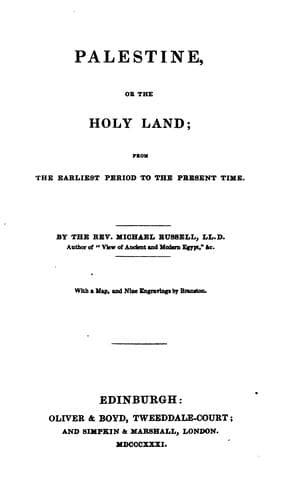
Palestine, or, the Holy Land: From the Earliest Period to the Present TimeRussell, Michael
History
Palestine, or, the Holy Land: From the Earliest Period to the Present Time
Russell, Michael
Palestine -- Description and travel; Palestine -- History
It may be said of the Hebrews, that they had no profane literature, no
works devoted to mere amusement or relaxation. As they admitted no image
of any thing in heaven or in earth, they consequently rejected the use of
all those arts called imitative, and which supply so large a portion of
the more refined enjoyment characteristic of civilized nations. In like
manner, they seem to have viewed in the light of sacrilege every attempt
to bring down the sublime language in which they praised Jehovah and
recorded his mighty works, to the more common and less hallowed purposes
of fictitious narrative, or of amatory, dramatic, and lyrical composition.
The Jews have no epic poem to throw a lustre on the early annals of their
literature. Even the Song of Songs is allowed to have a spiritual import,
pointing to much higher themes than Solomon and his Egyptian bride. A
solemn gravity pervades all their writings, befitting a people who were
charged with the religious history of the world and with the oracles of
Divine truth. No smile appears to have ever brightened the countenance of
a Jewish author,--no trifling thought to have passed through his mind,--no
ludicrous association to have been formed in his fancy. In describing the
flood of Deucalion, the Roman poet laughs at the grotesque misery which he
himself exhibits, and purposely groups together objects with the intention
of exerting to his readers the feeling of ridicule. But in no instance can
we detect the faintest symptom of levity in the Hebrew penmen; their
style, like their subject, is uniformly exalted, chaste, and severe; they
wrote to men concerning the things of God, in a manner suitable to such a
momentous communication; and they never ceased to remember that, in all
their records, whether historical or prophetic, they were employed in
propagating those glad tidings by which all the families of the earth were
to be blessed.
Public-domain text, read in full here on John Shaqi.
Reviews
Reviews
No reviews yet
Be the first to share your thoughts on this work.
Elsewhere in the archive
Join the Discussion
Join the discussion
Sign in to leave a comment or review.
Sign InorCreate an account