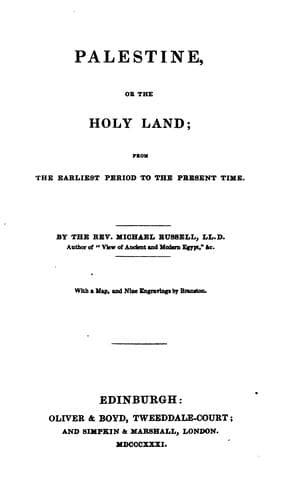
Palestine, or, the Holy Land: From the Earliest Period to the Present TimeRussell, Michael
History
Palestine, or, the Holy Land: From the Earliest Period to the Present Time
Russell, Michael
Palestine -- Description and travel; Palestine -- History
There can be no stronger proof of the pure and sublime nature of Hebrew
poetry than is supplied by the remarkable fact, that it has been
introduced into the service of the Christian church, and found suitable
for expressing those lofty sentiments with which the gospel inspires the
heart of every true worshipper. No other nation of the ancient world has
produced a single poem which could be used by an enlightened people in
these days for the purposes of devotion.[69] Hesiod, although much
esteemed for the moral tone of his compositions, presents very few ideas
indeed capable of being accommodated to the theology of an improved age.
In perusing the works of the greatest writers of paganism, we are struck
with a monstrous incongruity in all their conceptions of the Supreme
Being. The majesty with which the Hebrews surrounded Jehovah is entirely
wanting; the attributes belonging to the great Sovereign of the universe
are not appreciated; the providence of the Divine mind, united with
benevolence, compassion, and mercy, is never found to enter into their
descriptions of the eternal First Cause; while their incessant deviations
into polytheism outrage our religious feelings, and carry us back to the
verb rudest periods of human history.
In these respects the literature of the Jews is far exalted above that of
every other nation of which history has preserved any traces. It must be
acknowledged, that we remain ignorant of the learning and theological
opinions cultivated among the Persians at the time when the Jews were
under their dominion, and cannot therefore determine the precise extent to
which the dogmas of the captive tribes were affected by their intercourse
with a race of men who certainly taught the doctrine of the Divine unity,
and abstained from idolatrous usages. But confining our judgment even to
the oldest compositions of the Hebrews, those, for example, which may be
traced to the days of Moses, of Samuel, and of David, we cannot hesitate
to pronounce that they are distinguished by a remarkable peculiarity,
indicating by the most unambiguous tokens, that, in all things pertaining
to religious belief, the descendants of Jacob were placed under a special
superintendence and direction.
CHAPTER V.
_Description of Jerusalem_.
Public-domain text, read in full here on John Shaqi.
Reviews
Reviews
No reviews yet
Be the first to share your thoughts on this work.
Elsewhere in the archive
Join the Discussion
Join the discussion
Sign in to leave a comment or review.
Sign InorCreate an account