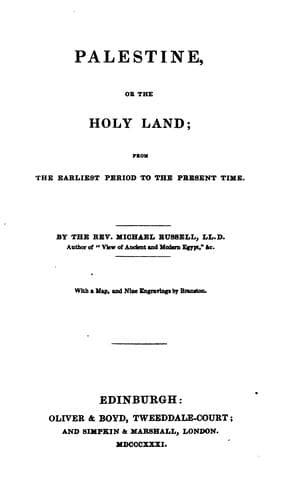
Palestine, or, the Holy Land: From the Earliest Period to the Present TimeRussell, Michael
History
Palestine, or, the Holy Land: From the Earliest Period to the Present Time
Russell, Michael
Palestine -- Description and travel; Palestine -- History
About the year 705, Jerusalem and its holy places were visited by
Arculfus, from whose report Adamnan composed a narrative, which was
received with considerable approbation. He describes the Temple on Mount
Calvary with some minuteness, mentioning its twelve pillars and eight
gates. But his attention was more particularly attracted by relics, those
objects which all Jerusalem flocked to handle and to kiss with the
greatest reverence. He saw the cup used at the last supper,--the sponge on
which the vinegar was poured,--the lance which pierced the side of our
Lord,--the cloth in which he was wrapped,--also another cloth woven by the
Virgin Mary, whereon were represented the figures of the Saviour and of
the Twelve Apostles.
Eighty years later, Willibald, a Saxon, undertook the same journey,
influenced by similar motives. From his infancy he had been distinguished
by a sage and pious disposition; and, on emerging from boyhood, he was
seized with an anxious desire to "try the unknown ways of
peregrination--to pass over the huge wastes of ocean to the ends of the
earth." To this erratic propensity he owed all the fame which a place in
the Romish calendar and the authorship of an indifferent book can confer.
In Jerusalem he saw all that Arculfus saw, and nothing more; but he had
previously visited the Tomb of the Seven Sleepers, and the cave in which
St. John wrote the Apocalypse.
Bernard proceeded to Palestine in the year 878. He travelled first in
Egypt, and from thence made his way across the Desert, the heat of which
called vividly to his imagination the sloping hills of Campania when
covered with snow. At Alexandria he was subjected to tribute by the
avaricious governor, who paid no regard to the written orders of the
sultan. The treatment which he received at Cairo was still more
distressing. He was thrown into prison, and in this extremity he asked
counsel of God; whereupon it was miraculously revealed to him, that
thirteen denari, such as he had presented to the other Mussulman, would
produce here an equally favourable result. The celestial origin of this
advice was proved by its complete success. The pilgrim was not only
liberated, but obtained letters from the propitiated ruler which saved him
from all farther exaction.
Public-domain text, read in full here on John Shaqi.
Reviews
Reviews
No reviews yet
Be the first to share your thoughts on this work.
Elsewhere in the archive
Join the Discussion
Join the discussion
Sign in to leave a comment or review.
Sign InorCreate an account