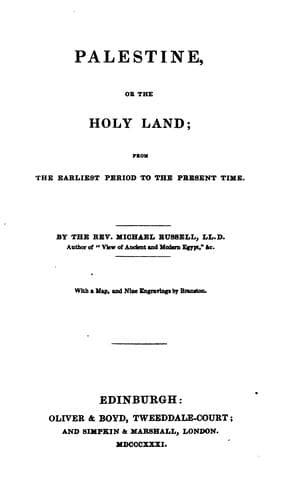
Palestine, or, the Holy Land: From the Earliest Period to the Present TimeRussell, Michael
History
Palestine, or, the Holy Land: From the Earliest Period to the Present Time
Russell, Michael
Palestine -- Description and travel; Palestine -- History
The Crusades threw open the holy places to the eyes of all Europe; and
accordingly, so long as a Christian king swayed the sceptre in the capital
of Judea, the merit of individual pilgrimage was greatly diminished. But
no sooner had the warlike Saracens recovered possession of Jerusalem than
the wonted difficulty and danger returned; and, as might be expected, the
interest attached to the sacred buildings, which the "infidel dogs" were
no longer worthy to behold, revived in greater vigour than formerly. In
1331, William de Bouldesell adventured on an expedition into Arabia and
Palestine, of which some account has been published. In the monastery of
St. Catharine, at the base of Mount Sinai, he was hospitably received by
the monks, who showed him the bones of their patron reposing in a tomb,
which, however, they appear not to have treated with much respect. By
means of hard beating, we are told, they brought out from these remains of
mortality a small portion of blood, which they presented to the pilgrim as
a gift of singular value. A circumstance which particularly astonished him
would probably have produced no surprise in a less believing mind; the
blood, it seems, "had not the appearance of real blood, but rather of some
thick oily substance;" nevertheless, the miracle was regarded by him as
one of the greatest that had ever been witnessed in this world.
A hundred years afterward Bertrandon de la Broquiere sailed from Venice to
Jaffa, where, according to the statistics of contrite pilgrims, the
"pardons of the Holy Land begin." At Jerusalem he found the Christians
reduced to a state of the most cruel thraldom. Such of them as engaged in
trade were locked up in their shops every night by the Saracens, who
opened the doors in the morning at such an hour as seemed to them most
proper or convenient. At Damascus they were treated with equal severity.
The first two persons whom he met in this city knocked him down,--an
injury which he dared not resent for fear of immediately losing his life.
About thirty years before the period of his visit, the destroying arms of
Timur had laid a large portion of the Syrian capital in ruins, though the
population had again increased to nearly one hundred thousand. During his
stay he witnessed the arrival of a caravan consisting of more than three
thousand camels. Its entry employed two days and two nights; the Koran
wrapped in silk being carried in front on the back of a camel richly
adorned with the same costly material. This part of the procession was
surrounded by a number of persons brandishing naked swords, and playing on
all sorts of musical instruments. The governor, with all the inhabitants,
went out to meet the holy cavalcade, and to do homage to the sacred
ensign, which at once proclaimed their faith, and announced the object of
the pious mission thus successfully concluded. Broquiere found the
greatest respect paid to every one who had performed the pilgrimage to
Public-domain text, read in full here on John Shaqi.
Reviews
Reviews
No reviews yet
Be the first to share your thoughts on this work.
Elsewhere in the archive
Join the Discussion
Join the discussion
Sign in to leave a comment or review.
Sign InorCreate an account