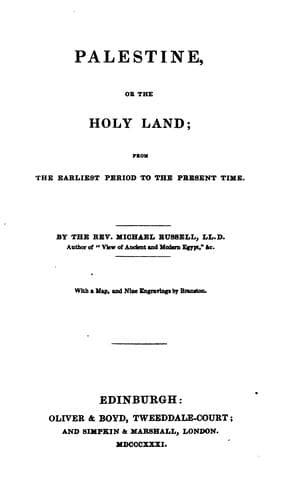
Palestine, or, the Holy Land: From the Earliest Period to the Present TimeRussell, Michael
History
Palestine, or, the Holy Land: From the Earliest Period to the Present Time
Russell, Michael
Palestine -- Description and travel; Palestine -- History
Of the people of Cyprus he remarks, that they "be very rude, and like
beasts, and no better: they eat their meat sitting upon the ground, with
their legs acrosse like tailors." On the 8th of August they arrived at
Joppa, but did not till the next day receive permission to land from the
great pasha, "who sate upon a hill to see us sent away." Aldersey had
mounted before the rest, which greatly displeased his highness, who sent a
servant to pull him from the saddle and beat him; "whereupon I made a long
legge, saying, Grand mercye, seignor." This timely submission seems to
have secured forgiveness; and accordingly, "being horsed upon little
asses," they commenced their journey towards Jerusalem. Rama he describes
as so "ruinated, that he took it to be rather a heape of stones than a
towne;" finding no house to receive them but such a one as they were
compelled to enter by creeping on their knees. The party were exposed to
the usual violence and extortion of the Arabs; "they that should have
rescued us stood still, and durst doe nothing, which was to our cost." On
reaching the holy city they knelt down and gave thanks; after which they
were obliged to enter the gate on foot, no Christian at that period being
allowed to appear within the walls mounted. The superior of the convent
received the pilgrims courteously into his humble establishment, where
Aldersey tells us, "they were dieted of free cost, and fared reasonable
well."[70]
The beginning of the seventeenth century witnessed a higher order of
travellers, who, from such a mixture of motives as might actuate either a
pilgrim or an antiquary, undertook the perilous tour of the Holy Land.
Among these, one of the most distinguished was George Sandys, who
commenced his peregrinations in the year 1610. He was succeeded by
Doubdan, Cheron, Thevenot, Gonzales, Morison, Maundrell, and Pococke, all
of whom have contributed many valuable materials towards a complete
knowledge of the localities, government, and actual condition of modern
Palestine. In our own days the number of works on these important subjects
has increased greatly, presenting to the historian of the Turkish
provinces in Asia a nearer and more minute view of society than could be
obtained by the earlier travellers, who, instead of yielding to the
characteristic bigotry of Moslem, usually opposed to it a prejudice not
less determined and uncharitable. We must not hazard a catalogue of the
enterprising authors to whom the European public are indebted for the
information: now enjoyed by every class of readers, in regard to the most
interesting of all ancient kingdoms,--the country inhabited by Israel and
Judah. In the description which we are about to give of the principal
towns, the buildings, the antiquities, the manners, the opinions, and the
religious forms which meet the observation of the intelligent tourist in
the Land of Canaan, we shall select the most striking facts from writers
Public-domain text, read in full here on John Shaqi.
Reviews
Reviews
No reviews yet
Be the first to share your thoughts on this work.
Elsewhere in the archive
Join the Discussion
Join the discussion
Sign in to leave a comment or review.
Sign InorCreate an account