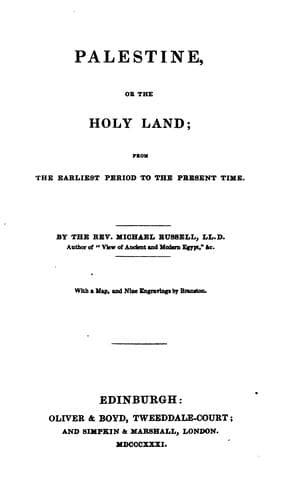
Palestine, or, the Holy Land: From the Earliest Period to the Present TimeRussell, Michael
History
Palestine, or, the Holy Land: From the Earliest Period to the Present Time
Russell, Michael
Palestine -- Description and travel; Palestine -- History
of all nations and sects, making no distinction but such as shall be
dictated by a respect for the learning, the candour, and the opportunities
which are recorded in their several volumes.
Palestine is usually approached, either from the sea at the port of Jaffa
(the ancient Joppa), or from Egypt, by way of the intervening desert. In
both cases, the principal object is to obtain a safe and easy route to the
capital, which, even at the present hour, cannot be reached without much
danger, unless under the special protection of the native authorities. The
power of Mohammed Ali, it is true, extends almost to the very walls of
Gaza; and wherever his government is acknowledged no violence can be
committed with impunity on European travellers. But the Syrian pashas,
equally deficient in inclination and vigour, still permit the grossest
extortion, and sometimes connive at the most savage atrocities. Besides,
there is a class of lawless Arabs who scour the borders of the wilderness,
holding at defiance all the restrictions which a civilized people impose
or respect. Sir Frederick Henniker, who followed the unwonted track which
leads from Mount Sinai to the southern shore of the Dead Sea, narrowly
escaped with his life, after having been severely wounded and repeatedly
robbed by one of the most savage hordes of Bedouins.
The history of the crusades will draw our attention to Jaffa more minutely
than would be suitable at the present stage of our narrative; we shall
therefore proceed on the usual route to Jerusalem, collecting as we go
along such notices as may prove interesting to the reader. At a short
distance from this celebrated port the pilgrim enters the plain of Sharon,
celebrated in Scripture for its beautiful roses. The monk Neret informs
us, that in his time it was covered with tulips, the variety of whose
colours formed a lovely parterre. At present, the eye of the traveller is
delighted with a profusion of roses white and red, the narcissus, the
white and orange lily, the carnation, and a highly-fragrant species of
everlasting-flower. This plain stretches along the coast from Gaza in the
south to Mount Carmel on the north, being bounded towards the east by the
hills of Judea and Samaria. The whole of it is not upon the same level; it
consists of four platforms separated from each other by a wall of naked
stones. The soil is composed of a very fine sand, which, though mixed with
ravel, appears extremely fertile; but owing to the desolating spirit of
Mohammedan despotism, nothing is seen in some of the richest fields except
thistles and withered grass. Here and there, indeed, are scanty
plantations of cotton, with a few patches of doura, barley, and wheat. The
villages, which are commonly surrounded with olive-trees and sycamores,
are for the most part in ruins; exhibiting a melancholy proof that under a
bad government even the bounty of Heaven ceases to be a blessing.
Public-domain text, read in full here on John Shaqi.
Reviews
Reviews
No reviews yet
Be the first to share your thoughts on this work.
Elsewhere in the archive
Join the Discussion
Join the discussion
Sign in to leave a comment or review.
Sign InorCreate an account