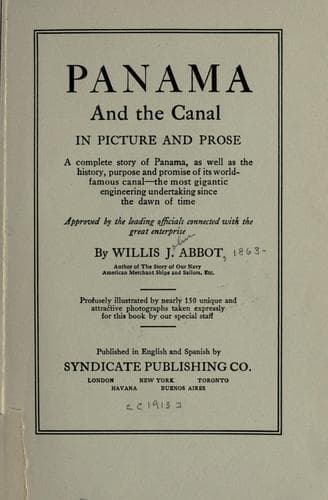
Panama and the Canal in Picture and ProseAbbot, Willis J. (Willis John)
History
Panama and the Canal in Picture and Prose
Abbot, Willis J. (Willis John)
Panama Canal (Panama) -- History
While the ruins of Old Panama compare but unfavorably with those of
Porto Bello or San Lorenzo, their proximity to the city of Panama make
them a favorite point of interest for tourists. Half a day is ample to
give to the drive out and back and to the inspection of the ruins
themselves. The extended area over which they are scattered testifies to
the size of the obliterated city, while the wide spaces, destitute of
any sign of occupation, which intervene between the remaining relics,
shows clearly that the greater part of the town must have been built of
perishable materials easily swept away at the time of the fire, or
slowly disintegrating during the flood of years that have since rolled
by. The tower of the Cathedral of St. Augustine alone among the relics
still remaining affords any suggestion of grandeur or even of
architectural dignity.
To reach the ruins you take a horse, a carriage or an automobile for a
ride of about five miles over an excellent road laid and maintained by
the Republic of Panama. If you go by horseback the old trail which the
pirates used is still traceable and at low tide one can ride along the
beach. For the majority the drive along the road, which should be taken
in the early morning, is the simpler way, though there was promise in
1913 that within a few months a trolley line would still further
simplify the trip.
From Balboa, the Pacific opening of the Panama Canal, and the newest of
the world’s great ports, to the ruins of Old Panama, founded in 1609 and
obliterated by pirates in 1671, by trolley in two hours! Was ever the
past more audaciously linked to the present? Were ever exhibits of the
peaceful commerce of today and the bloody raids of ancient times placed
in such dramatic juxtaposition?
The road to Old Panama runs through a peaceful grazing country, with a
very few plantations. One or two country residences of prosperous
Panamanians appear standing well back from the road, but signs of life
and of industry are few. The country lies high, is open and free from
jungle and in almost any North American state, lying thus close to a
town of 40,000 people and adjacent to a district in which the United
States is spending some millions of dollars a month, would be platted in
additions for miles around, and dotted with the signs of real estate
dealers. But the Panamanian mind is not speculative, or at any rate
soars little above the weekly lottery ticket. So all Uncle Samuel’s
disbursements in the Zone have thus far produced nothing remotely
resembling a real estate boom.
Public-domain text, read in full here on John Shaqi.
Reviews
Reviews
No reviews yet
Be the first to share your thoughts on this work.
Elsewhere in the archive
Join the Discussion
Join the discussion
Sign in to leave a comment or review.
Sign InorCreate an account