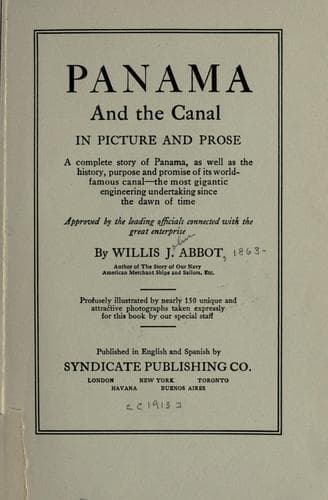
Panama and the Canal in Picture and ProseAbbot, Willis J. (Willis John)
History
Panama and the Canal in Picture and Prose
Abbot, Willis J. (Willis John)
Panama Canal (Panama) -- History
However as we turn off from the main road toward the sea and the square
broken tower of the old cathedral, or Church of St. Augustine, with the
ferns springing from the jagged top, and vines twisting out through the
dumbly staring windows, real estate and “booms” seem singularly ignoble
topics in the presence of this mute spectator of the agonies of a
martyred people. For even the dulling mists of the interposing
centuries, even our feeling that the Spaniards suffered only the anguish
and the torments which they had themselves meted out to the real owners
of the lands they had seized upon, cannot wholly blunt the sense of pity
for the women and children, for the husbands and fathers in the city
which fell under Morgan’s blight. It would be no easy task to gather in
the worst purlieus of any American city today a band so wholly lost to
shame, to pity and to God as the ruffians who followed Morgan. What they
did to the people on whom their hands reeking with blood were laid must
be left to the imagination. The only contemporary record of the sack was
written by one of their own number to whom apparently such scenes had
become commonplace, for while his gorge rises at the contemplation of
his own hard fortune in being robbed and deserted by his chief, he
recounts the torture of men and the violation of women in a
matter-of-fact way as though all in the day’s work.
[Illustration: BLUFF NEAR TORO POINT
Photographing this scene is now prohibited as a United States fort is to
be erected here]
Driving on we come to the arched bridge which formed the main entrance
to the town in the day of its downfall. Sturdy it is still, though the
public road no longer passes over it, defying the assaults of time and
the more disintegrating inroads of the tropical plants which insinuate
themselves into every crevice, prying the stone apart with tender
fingers ever hardening. At once the bridge, none too wide for three to
cross abreast, awakens wonder that no Horatius was in all the Spanish
armies to keep the bridge as did he of ancient Rome. But after all the
rivulet which today makes its sluggish way under the arch is no Tiber to
hold the invading army at bay. Perhaps it was bigger in Morgan’s time;
today it would be easily forded, almost leapt. At any rate no
“Dauntless Three” like those Macaulay sung were there to stay the
onrolling tide of foemen.
[Illustration: “WHETHER THE TREE OR THE WALL IS STOUTER IS A PROBLEM”]
Public-domain text, read in full here on John Shaqi.
Reviews
Reviews
No reviews yet
Be the first to share your thoughts on this work.
Elsewhere in the archive
Join the Discussion
Join the discussion
Sign in to leave a comment or review.
Sign InorCreate an account