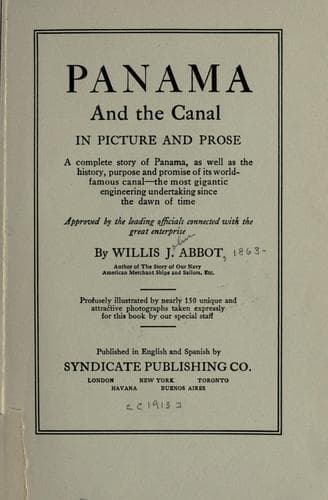
Panama and the Canal in Picture and ProseAbbot, Willis J. (Willis John)
History
Panama and the Canal in Picture and Prose
Abbot, Willis J. (Willis John)
Panama Canal (Panama) -- History
Hardly have we passed the bridge than a massive vine-embedded ruin on
the left of the road stands mute evidence that the Spaniards had forts,
if they had but possessed the courage to defend them. This is the Casa
Reale, or government house. Its walls of rubble masonry are full two
feet thick and have the appearance of having been pierced for musketry.
If the buccaneers had any artillery at all, which is doubtful, it was
hardly heavy enough to have had any effect against such a wall. Secure
within the Casa Reale such a handful of men as held the Alamo against
the Mexicans could have resisted Morgan’s men indefinitely. But the
spirit was lacking. The stout walls of the Casa Reale stand now as
evidences of the character of the defenses the people of Panama had if
they but had the pluck to use them.
Continuing toward the sea the visitor next comes upon the ruins of the
Cathedral, which are in so shattered a state as to justify the belief
that either the invaders or the Spaniards themselves employed gunpowder
to wreck so massive an edifice. The flames and the work of the
vegetation could hardly have accomplished such complete destruction. The
tower alone retains definite form, rising about fifty feet from a dense
jungle, and lined within with vines and clinging trees that use the
ancient walls as a support and hasten their disintegration in so doing.
It is difficult even to trace the lines of the great church, so
thoroughly have its walls been demolished. Some of the massive arches
still stand all pendulous with vines.
At the water’s edge one still finds steps leading down into the sea, and
the remains of the old paved road to which at high tide the boats could
come with their cargoes of fish and country produce. If one happens to
visit the spot at low tide the view looking seaward is as ugly as could
well be imagined. The hard sand beach extends only to high water mark.
Beyond that for more than a mile seaward extends a dismal range of black
mud of about the consistency of putty. Near the shore it is seen to be
full of round holes from which crawl unsightly worms and small crabs. E.
C. Stedman puts its unsightly appearance in two lines:
“The tide still ebbs a league from quay,
The buzzards scour the empty bay.”
Public-domain text, read in full here on John Shaqi.
Reviews
Reviews
No reviews yet
Be the first to share your thoughts on this work.
Elsewhere in the archive
Join the Discussion
Join the discussion
Sign in to leave a comment or review.
Sign InorCreate an account