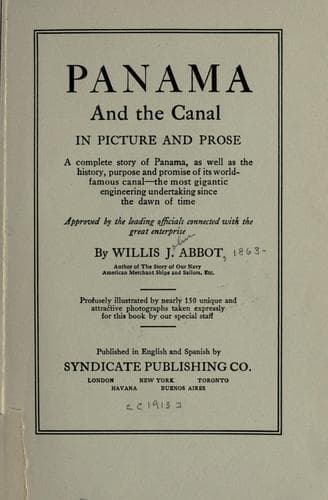
Panama and the Canal in Picture and ProseAbbot, Willis J. (Willis John)
History
Panama and the Canal in Picture and Prose
Abbot, Willis J. (Willis John)
Panama Canal (Panama) -- History
The search for the natural waterway had hardly been abandoned when
discussion arose as to the practicability of creating an artificial one.
In its earlier days this project encountered not only the physical
obstacles which we had to overcome, but others springing from the rather
exaggerated piety of the time. Yet it was a chaplain to Cortez who first
suggested a canal to Philip II of Spain in words that have a good
twentieth-century ring to them, though their form be archaic: “It is
true,” he wrote, “that mountains obstruct these passes, but if there be
mountains there are also hands.” That is the spirit in which Uncle Sam
approached the Big Job. But when the sturdy chaplain’s appeal came to
King Philip he referred it to the priests of his council, who ruled it
out upon the scriptural injunction, “What God hath joined together let
no man put asunder,” and they were backed up by a learned prelate on the
Isthmus, Fray Josef de Acosta, who averred, “No human power will suffice
to demolish the most strong and impenetrable mountains, and solid rocks
which God has placed between the two seas, and which sustain the fury of
the two oceans. And when it would be to men possible it would in my
opinion be very proper to fear the chastisement of heaven for wishing to
correct the works which the Creator with greatest deliberation and
foresight ordained in the creation of this universe.”
[Illustration: SAN PABLO LOCK IN FRENCH DAYS]
Doubtless the Fray de Acosta was the more orthodox, but we like better
the spirit of the cleric who held the somewhat difficult post of
spiritual adviser to Cortez. His belief that “if there are mountains
there are also hands” is good doctrine, and we can believe that the good
father would have liked to have seen some of Col. Goethals’ steam
shovels biting into those mountains at five cubic yards a bite.
It seems strange that the four canal routes over the respective merits
of which the Senate of the United States was engaged in seemingly
interminable wrangle only a few years ago--Nicaragua, Darien, Panama and
Tehuantepec--should have been suggested by Cortez in the sixteenth
century. Nearly 250 years before the birth of the republic destined to
dig the canal this stout explorer from old Spain laid an unerring finger
upon the only routes which it could follow. Doubtless it was as well
that no effort was made at the time, yet it would be unwise for us with
smug twentieth-century self-sufficiency to assert that no other age than
ours could have put the project through. Perhaps the labor and skill
that raised the mighty city of Palmyra, or built the massive aqueducts
that in ruins still span the Roman Campagna, or carved the Colossi of
the Egyptian desert, might have been equal to the Panama problem.
Public-domain text, read in full here on John Shaqi.
Reviews
Reviews
No reviews yet
Be the first to share your thoughts on this work.
Elsewhere in the archive
Join the Discussion
Join the discussion
Sign in to leave a comment or review.
Sign InorCreate an account