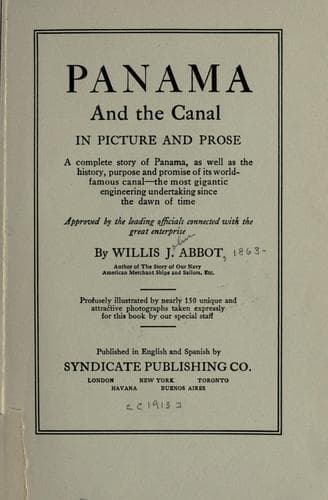
Panama and the Canal in Picture and ProseAbbot, Willis J. (Willis John)
History
Panama and the Canal in Picture and Prose
Abbot, Willis J. (Willis John)
Panama Canal (Panama) -- History
In 1814 the Spanish cortes ordered surveys made for a canal, but nothing
came of it, and the great project lay quiescent as long as Spain’s power
in the Isthmus remained unshaken. More by the indifference of other
nations than by any right of their own, the Spanish had assumed
sovereignty over all of South and Central America. That they held the
country by virtue of a papal bull--such as that may be--and by right of
conquest is undeniable. But men begun to say that the Pope had given
Spain something he never owned, while so far as conquest was concerned
Morgan had taken from the Spanish all they ever won by force of arms on
the Isthmus. He did not hold what he had taken because he was a pirate
not a pioneer.
[Illustration: PART OF THE SEA WALL AT PANAMA]
The only serious effort to colonize in the Panama region by any people,
save Spaniards, was the founding of a colony of Scotch Presbyterians,
headed by one William Patterson, who had occupied a Scotch pulpit.
Beside theology he must have known something of finance, for he
organized, and was one of the first directors of, the Bank of England.
His colonization project in Panama was broadly conceived, but badly
executed. Taking the rich East India Company for a model he secured a
franchise from Scotland, granting him a monopoly of Scottish trade in
the Indies in return for an annual tribute of one hogshead of tobacco.
Capitalizing his company for $600,000, he backed the shares with his
reputation as a founder of the bank and saw the capital over-subscribed
in London. But the success woke up his rivals. They worked on the King,
persuaded him to denounce the action taken in Scotland and pushed a law
through the English Parliament outlawing the Scotch company in England.
In every country the people interested in the established companies
fought the interloper who was trying to break into their profitable
demesne. But the Scotch stuck to their guns. They rallied at first about
Patterson as in later years the French flocked to the support of De
Lesseps. Ships were built in Amsterdam, pistols were bought by
wholesale, brandy and bibles were both gathered in large quantities, and
in 1768 volunteers were called for to join the expedition. Every settler
was promised fifty acres of agricultural land and one fifty-foot town
lot.
[Illustration: THE PELICANS IN THE BAY OF PANAMA]
Public-domain text, read in full here on John Shaqi.
Reviews
Reviews
No reviews yet
Be the first to share your thoughts on this work.
Elsewhere in the archive
Join the Discussion
Join the discussion
Sign in to leave a comment or review.
Sign InorCreate an account