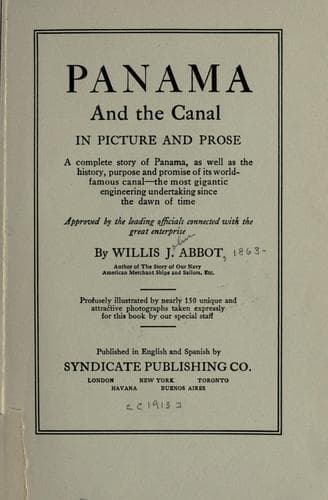
Panama and the Canal in Picture and ProseAbbot, Willis J. (Willis John)
History
Panama and the Canal in Picture and Prose
Abbot, Willis J. (Willis John)
Panama Canal (Panama) -- History
Disheartened, the first colony broke up and sailed away, just when the
Company was dispatching two more ships from Scotland. The fugitives
sailed for New York, and on one of their ships carrying 250 men, 150 are
said to have died before reaching that port. As for the new colonists,
they reached the deserted fort of St. Andrew, and saw the mute evidences
of death and despair. From the Indians they learned the details of the
story, and a great majority voted to sail away without further delay.
Twelve however elected to stop, and being landed with a generous supply
of provisions, kept foothold in the colony until the third expedition
arrived. This consisted of four ships, which had left the Clyde with
about 1300 colonists. About 160 however died on the way out, and the
survivors were mightily distressed when instead of finding a thriving
colony of a thousand or more awaiting them, they discovered only twelve
Scotchmen living miserably in huts with the Indians.
The imaginative prospectus writer seems to have been no less active and
engaging at that time than in these days of mining promotions, and many
of the new colonists had come in the expectation of finding a land
watered by springs, the waters of which were “as soft as milk and very
nourishing,” a land wherein people lived 150 years, and to die at 125
was to be cut off in the flower of one’s youth. What they found was
twelve haggard Scotchmen in a primeval forest, ill-fed, unclothed,
dependent largely on the charity of the Indians, and who, so far from
looking confidently forward to an hundred more years of life cried
dolorously to the newcomers, “Take us hence or we perish.”
The new colonists, however, had pluck. Stifling their disappointment,
they disembarked and settled down to make the colony a success.
According to the records they had brought five forces for disintegration
and failure along with them--namely four ministers and a most prodigious
lot of brandy. The ancient chroniclers do not say upon which of these
rests the most blame for the disasters that followed. The ministers
straightway set up to be rulers of the colony. When stockades should be
a-building all were engaged in erecting houses for them. As but two
could preach in the space of one Sunday, they designated two holy days
weekly whereon they preached such resounding sermons that “the regular
service frequently lasted twelve hours without any interruption.” Nor
would they do other work than sermonizing. As for the brandy, all the
records of the colony agree that much too much of it and of the curious
native drinks was used by all, and that the ministers themselves were
wont to reinvigorate themselves after their pulpit exertions by mighty
potations.
[Illustration: CHILDREN IN A NATIVE HUT]
Public-domain text, read in full here on John Shaqi.
Reviews
Reviews
No reviews yet
Be the first to share your thoughts on this work.
Elsewhere in the archive
Join the Discussion
Join the discussion
Sign in to leave a comment or review.
Sign InorCreate an account