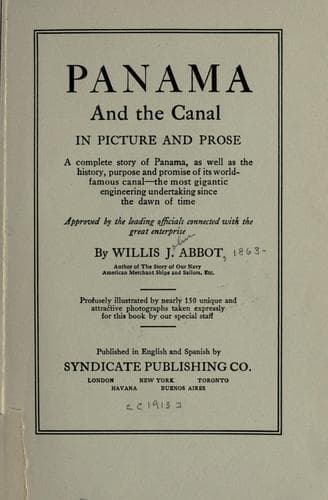
Panama and the Canal in Picture and ProseAbbot, Willis J. (Willis John)
History
Panama and the Canal in Picture and Prose
Abbot, Willis J. (Willis John)
Panama Canal (Panama) -- History
Yet the colony was not wholly without a certain sturdy self reliance.
Seeing it persist despite all obstacles, the Spaniards dispatched a
force of soldiers from Panama to destroy it. Campbell waylaid them in
the jungle and overthrew them. Then the King of Spain became alarmed and
sent eight Spanish men-of-war to make an end of these interlopers--the
King of England and Scotland coldly leaving them to their fate. But they
fought so bravely that in the end the Spanish, though their fleet had
been reënforced by three ships, were obliged to grant them capitulation
with the honors of war, and they “marched out with their colors flying
and drums beating, together with arms and ammunition, and with all their
goods.”
[Illustration: THE WATER FRONT OF PANAMA]
So ended the effort to make of Darien an outpost of Scotland. In the
effort 2000 lives and over £200,000 had been lost. Macaulay explains it
by saying, “It was folly to suppose that men born and bred within ten
degrees of the Arctic circle would enjoy excellent health within ten
degrees of the equator.” But Lord Macaulay forgot to reckon on the
hostility of the East India Company, whose monopoly was threatened, the
plenteousness of the brandy and the zeal of the four ministers.
[Illustration: THE WATER GATE OF PANAMA]
After the expulsion of the Scotch, the domination of the Isthmus by the
Spaniards was never again seriously menaced by any foreign power. All
the vast South and Central American domain was lost to Spain, not by the
attacks of her European neighbors, but by the revolt of their people
against a government which was at one time inefficient and tyrannical.
The French Revolution and the Napoleonic upheaval in Europe found their
echo in South America, where one after another the various states threw
off the Spanish yoke. But Panama, then known as Terra Firma, was slow to
join in the revolutionary activities of her neighbors. It is true that
in 1812 the revolutionists became so active in Bogotá, the capital of
the province, that the seat of government was temporarily removed to
Panama City. But the country as a whole was sluggish.
Public-domain text, read in full here on John Shaqi.
Reviews
Reviews
No reviews yet
Be the first to share your thoughts on this work.
Elsewhere in the archive
Join the Discussion
Join the discussion
Sign in to leave a comment or review.
Sign InorCreate an account