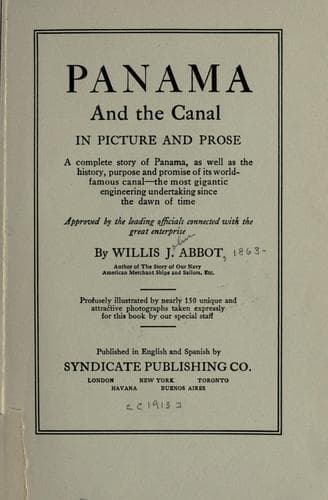
Panama and the Canal in Picture and ProseAbbot, Willis J. (Willis John)
History
Panama and the Canal in Picture and Prose
Abbot, Willis J. (Willis John)
Panama Canal (Panama) -- History
Of course, during all the revolutions and counter revolutions the idea
of the canal had steadily grown. England at one time took a mild
interest in it and sent one Horatio Nelson to look over the land. The
young naval officer’s health failed him and he returned to become in
later years the hero of Trafalgar and the Nile. Later, the great German
scientist, Baron von Humboldt, in the course of a famous voyage to South
America, spent some time on the Isthmus, and wrote much of its natural
features, enumerating nine routes for a canal including of course the
one finally adopted. Louis Napoleon, though never on the Isthmus,
dreamed out the possibilities of a canal when he was a prisoner in the
fortress of Ham. Had he succeeded in maintaining Maximilian on the
throne of Mexico he might have made the Isthmian history very different.
Among our own people, De Witt Clinton, builder of the Erie Canal, and
Henry Clay, were the first to plan for an American canal across the
Isthmus, but without taking practical steps to accomplish it.
Canal schemes, however, were almost as numerous as revolutions in the
years preceding 1903. Darien, Panama, Tehuantepec, Nicaragua have all
been considered at various times, and the last named for some time was a
very close second to Panama in favor. There is reason to believe that
the government of the United States deliberately “nursed” the Nicaragua
project in order to exact better terms from Colombia, which held the
Panama route at an exorbitant figure.
[Illustration: ANCON HILL AT SUNSET]
The honor of actually inaugurating the canal work must ever belong to
the French, as the honor of completing it will accrue to us. It is not
the first time either that the French and the Americans worked together
to accomplish something on this continent. Yorktown and Panama ought to
be regarded as chapters of the story of a long partnership. In 1876
Ferdinand de Lesseps, with the glory of having dug the Suez Canal still
untarnished, became interested in the Panama situation as the result of
representations made by a French engineer, Napoleon B. Wyse. Lieut. Wyse
had made a survey of the Isthmus and, in connection with Gen. Stephen
Turr, a Hungarian, had secured a concession from Colombia to run
ninety-nine years after the completion of the canal, with a payment to
Colombia of $250,000 annually after the seventy-fifth year had expired.
This franchise was transferable by sale to any other private company but
could not be sold to a government--a proviso which later complicated
greatly the negotiations with the United States.
[Illustration: _Photo by Underwood & Underwood_
ABANDONED FRENCH MACHINERY ON THE CANAL]
Public-domain text, read in full here on John Shaqi.
Reviews
Reviews
No reviews yet
Be the first to share your thoughts on this work.
Elsewhere in the archive
Join the Discussion
Join the discussion
Sign in to leave a comment or review.
Sign InorCreate an account