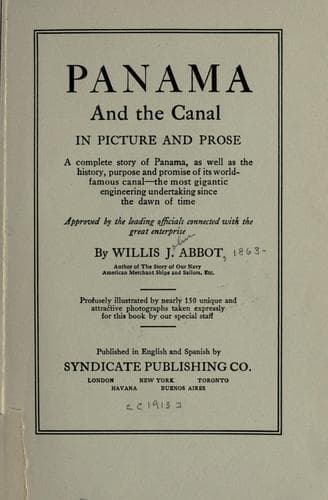
Panama and the Canal in Picture and ProseAbbot, Willis J. (Willis John)
History
Panama and the Canal in Picture and Prose
Abbot, Willis J. (Willis John)
Panama Canal (Panama) -- History
Revolutions were annual occurrences, sometimes hard fought, for the
people of Panama have plenty of courage in the field; sometimes ended
with the first battle. The name of the parent state has been sometimes
Colombia, sometimes New Granada; Panama has at times been independent,
at others a state of the Federation of New Granada; at one time briefly
allied with Ecuador and Venezuela. In 1846 the volume of North American
travel across the Isthmus became so great that the United States
entered into a treaty with New Granada in which we guaranteed to keep
the Isthmus open for transit. That and the building, by American capital
of the Panama Railroad, made us a directly interested party in all
subsequent revolutions. Of these there were plenty. President Theodore
Roosevelt, defending in 1903 the diplomatic methods by which he “took”
Panama, enumerated no fewer than fifty-three revolutions in the
fifty-seven years that had elapsed since the signing of the treaty. He
summed up the situation thus:
“The above is only a partial list of the revolutions, rebellions,
insurrections, riots, and other outbreaks that have occurred during the
period in question; yet they number fifty-three for the last fifty-seven
years. It will be noted that one of them lasted nearly three years
before it was quelled; another for nearly a year. In short, the
experience of nearly half a century has shown Colombia to be utterly
incapable of keeping order on the Isthmus. Only the active interference
of the United States has enabled her to preserve so much as a semblance
of sovereignty. Had it not been for the exercise by the United States of
the police power in her interest, her connection with the Isthmus would
have been severed long ago.”
[Illustration: CATHEDRAL PLAZA, PANAMA
The building in the center was by turns the French and the American
Administration Building]
We are apt to think of these revolutions as mere riots, uprisings
somewhat after the sort of Falstaff’s seven men in buckram, and savoring
much of the opera bouffe. Such, to a great extent they were, and
curiously enough none of them, except for its outcome, was less serious
or dignified than the final one which won for Panama its freedom from
Colombia, and for the United States the ten miles’ strip across the
ocean called the Canal Zone. That was perhaps the only revolution in
history by which was created a new and sovereign-state, and the issue of
which was finally determined by the inability of a commanding general
to pay the fares for his troops over forty-eight miles of railroad. Of
that, however, more hereafter.
[Illustration: AVENIDA CENTRALE
The building with the rounded corner balcony is the American Consulate]
Public-domain text, read in full here on John Shaqi.
Reviews
Reviews
No reviews yet
Be the first to share your thoughts on this work.
Elsewhere in the archive
Join the Discussion
Join the discussion
Sign in to leave a comment or review.
Sign InorCreate an account