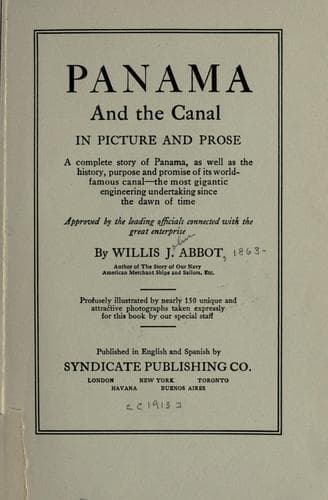
Panama and the Canal in Picture and ProseAbbot, Willis J. (Willis John)
History
Panama and the Canal in Picture and Prose
Abbot, Willis J. (Willis John)
Panama Canal (Panama) -- History
French connection with the canal was not that the first blast which it
had been prepared to celebrate with some pomp failed to explode, or that
the young engineers did not understand that champagne mixed but badly
with a humid and malarial climate, but that the flower of a great and
generous nation gave their lives in a struggle with hostile nature
before science had equipped man with the knowledge to make the struggle
equal.
[Illustration: WHERE THE FRENCH DID THEIR BEST WORK
The greatest amount of excavations by the French was in Culebra Cut]
Today along a great part of our canal line the marks of the French
attainments are apparent. From Limon Bay, at the Atlantic end of the
canal, our engineers for some reason determined upon an entirely new
line for our canal, instead of following the French waterway, which was
dug for seven miles to a depth of fifteen feet, and for eight miles
further, seven feet deep. This canal has been used very largely by our
force in carrying material for the Gatun dam. At the Pacific entrance
they had dug a narrow channel three miles long which we are still using.
We paid the French company $40,000,000 for all its rights on the
Isthmus. There are various rumors as to who got the money. Some, it is
believed, never went far from New York, for with all their thrift the
French are no match for our high financiers. But whoever got the money
we got a good bargain. The estimate of our own commission in 1911 values
the physical property thus transferred at $42,799,826.
Bad luck, both comic and tragic, seemed to attend the French endeavors.
Count De Lesseps, with a national fondness for the dramatic, arranged
two ceremonies to properly dignify the actual beginning of work upon the
canal. The first was to be the breaking of ground for the Pacific
entrance, which was to be at the mouth of the Rio Grande River in the
Bay of Panama. A distinguished company gathered on the boat chartered
for the occasion at Panama, and there was much feasting, speaking and
toasting. Every one was so imbued with enthusiasm that no one thought
of so material a thing as the tide. On the Pacific coast the tide rises
and falls twenty feet or more, and while the guests were emptying their
glasses the receding tide was emptying the bay whither they were bound.
When they arrived they found that nearly two miles of coral rock and mud
flats separated them from the shore where the historic sod was to be
turned. Accordingly, excavation was begun _pro forma_ in a champagne box
filled with earth on the deck of the ship. The little daughter of De
Lesseps dealt the first blow of the pick, followed by representatives of
Colombia. To complete the ceremony the Bishop of Panama gravely blessed
the work thus auspiciously begun, and the canal builders steamed back to
Panama.
[Illustration: AN OLD SPANISH CHURCH
This edifice, still standing at Nata, is said to be the oldest church in
Panama]
[Illustration: _Photo by Underwood & Underwood_
Public-domain text, read in full here on John Shaqi.
Reviews
Reviews
No reviews yet
Be the first to share your thoughts on this work.
Elsewhere in the archive
Join the Discussion
Join the discussion
Sign in to leave a comment or review.
Sign InorCreate an account