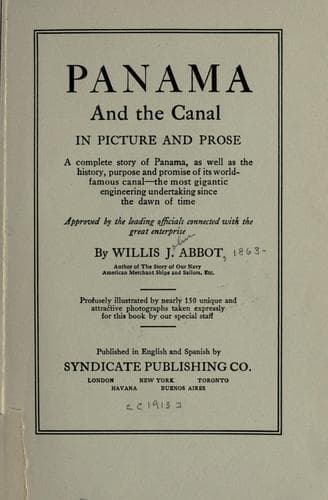
Panama and the Canal in Picture and ProseAbbot, Willis J. (Willis John)
History
Panama and the Canal in Picture and Prose
Abbot, Willis J. (Willis John)
Panama Canal (Panama) -- History
JUNCTURE OF FRENCH AND AMERICAN CANALS
The American Canal is the wider, and affords the more direct route to
the sea]
Later, the same party assembled to witness the first blast at
Culebra--for the French made the first attack on that redoubtable
fortress, which after the lapse of thirty-five years is stubbornly
resisting our American sappers and miners. But after due preparations,
including wine, the fair hand of Mlle. Ferdinande De Lesseps pressed the
button--and nothing happened. Some fault in the connections made the
electric spark impotent, and the chroniclers of the time do not record
exactly when the blast was actually fired. But in the official canal
paper the ceremony was described as “perfectly successful,” and the
reporter added that picturesque detail which Koko said “imparts an
artistic verisimilitude to an otherwise bald and uninteresting
statement of fact,” by saying that the rocks were “much less resistant
than we had expected.”
[Illustration: PART OF THE TOLL OF LIFE
This cemetery on the westerly slope of Ancon Hill is one of the Zone’s
pathetic spots]
These needless ceremonies and the false reports which attended them were
merely what in our cynical age and nation are called press-agent
“stunts,” and were necessitated by the need for interesting the French
people in the work, lest they let the market for the shares slump. They
were early symptoms of the evil that culminated in the revelations of
blackmail and forced tribute paid the French press when the final
collapse was impending and inevitable.
De Lesseps indeed was a master in the art of “working the press,” and
had he confined his activities to that, without interfering with his
engineers, history might have told a different story of his canal
management. But lest doubt should seize upon would-be investors, he
continually cut down the estimates of his engineers, and issued
flamboyant proclamations announcing triumphs that had not been won and
prophesying a rate of progress that never could be attained. When his
very capable Technical Commission, headed by Col. George M. Totten, the
builder of the Panama Railroad, estimated the total cost of the canal at
$168,600,000, he took the report to his cabin on shipboard and there
arbitrarily, with no possible new data, lopped off about $37,000,000.
Even at that, he calmly capitalized his company at 600,000,000 francs or
$120,000,000, though his own estimate of the cost of the canal exceeded
that amount by more than $12,000,000. One-half of his capital stock or
$60,000,000 the Count had reserved for the United States, but sold not a
dollar’s worth. The $60,000,000 first offered in France was, however,
eagerly subscribed. Of course it was wholly insufficient.
Public-domain text, read in full here on John Shaqi.
Reviews
Reviews
No reviews yet
Be the first to share your thoughts on this work.
Elsewhere in the archive
Join the Discussion
Join the discussion
Sign in to leave a comment or review.
Sign InorCreate an account