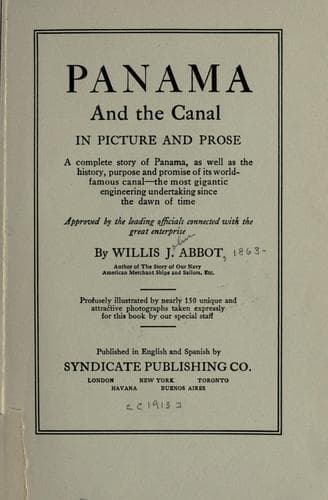
Panama and the Canal in Picture and ProseAbbot, Willis J. (Willis John)
History
Panama and the Canal in Picture and Prose
Abbot, Willis J. (Willis John)
Panama Canal (Panama) -- History
“Stand! Stand to your glasses steady,
’Tis all we have left to prize,
One cup to the dead already,
Hurrah, for the next that dies”.
Wine, wassail and, I fear, women were much in evidence during the hectic
period of the French activities. The people of the two Isthmian towns
still speak of it as the _temps de luxe_. Dismal thrift was banished and
extravagance was the rule. Salaries were prodigious. Some high officials
were paid from $50,000 to $100,000 a year with houses, carriages,
traveling expenses and uncounted incidentals. Expenditures for
residences were lavish, and the nature of the structures still standing
shows that graft was the chief factor in the cost. The director-general
had a $40,000 bath-house, and a private railway car costing
$42,000--which is curiously enough almost exactly $1000 for each mile of
the railroad it traversed. The hospital buildings at Colon cost
$1,400,000 and one has but to look at them today to wonder how even the
$400,000 was spent.
The big graft that finally was one of the prime factors in wrecking the
company was in Paris, but enough went on in Colon and Panama to make
those two towns as full of easy money as a mining camp after a big
strike. The pleasures of such a society are not refined. Gambling and
drinking were the less serious vices. A French commentator of the time
remarks, “Most of the commercial business of Panama is transacted
standing and imbibing cocktails--always the eternal cocktail! Afterward,
if the consumer had the time and money to lose, he had only to cross the
hall to find himself in a little room, crowded with people where
roulette was going on. Oh this roulette, how much it has cost all grades
of canal employees! Its proprietor must make vast profits. Admission is
absolutely free; whoever wishes may join in the play. A democratic mob
pushes and crowds around the table. One is elbowed at the same time by a
negro, almost in rags, anxiously thrusting forward his ten sous, and by
a portly merchant with his pockets stuffed with piasters and bank
notes”.
These towns, which bought and consumed French champagnes and other wines
by the shipload, could not afford to build a water system. Water was
peddled in the streets by men carrying great jars, or conducting carts
with tanks. There were millions for roulette, poker and the lottery, but
nothing for sewers or pavements and during the wet season the people,
natives and French both, waded ankle deep in filth which would have
driven a blooded Berkshire hog from his sty. When from these man-created
conditions of drink and dirt, disease was bred and men died like the
vermin among which they lived, they blamed the climate, or the Chagres
River.
Public-domain text, read in full here on John Shaqi.
Reviews
Reviews
No reviews yet
Be the first to share your thoughts on this work.
Elsewhere in the archive
Join the Discussion
Join the discussion
Sign in to leave a comment or review.
Sign InorCreate an account